.jpeg)
Avatrombopag: A Complete Guide to Dosage, Mechanism, and Clinical Use
1.Composition and Physicochemical Properties
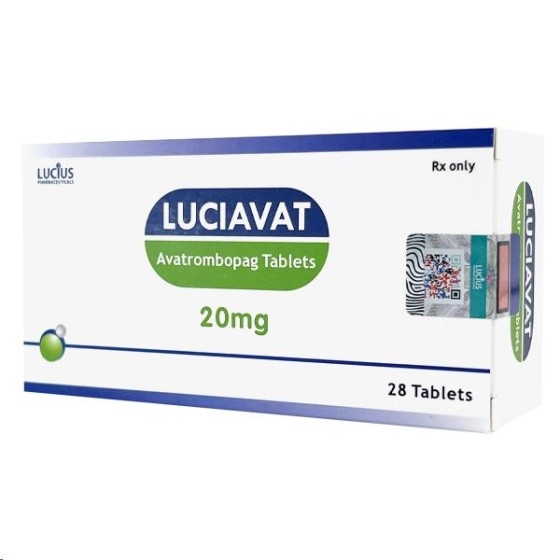
The active ingredient of avatrombopag is avatrombopag maleate,chemically designated as 1-(3-chloro-5-{[4-(4-chlorothiophen-2-yl)-5-(4-cyclohexylpiperazin-1-yl)-1,3-thiazol-2-yl]carbamoyl}pyridin-2-yl)piperidine-4-carboxylic acid maleate salt.Each film-coated tablet contains 20 mg of avatrombopag(as free base).Excipients include lactose,microcrystalline cellulose,croscarmellose sodium,and magnesium stearate.
Avatrombopag is a small-molecule,non-peptide TPO-RA that does not contain metal-chelating moieties.It is therefore unaffected by polyvalent cations in food and can be taken with meals without dietary restrictions,enhancing patient compliance.
2.Mechanism of Action
Avatrombopag binds specifically to the transmembrane domain of the thrombopoietin receptor(c-Mpl),activating the JAK-STAT,MAPK,and PI3K signaling pathways.This stimulates the proliferation,differentiation,and maturation of bone marrow megakaryocytes,ultimately promoting platelet production.
Unlike recombinant human thrombopoietin,avatrombopag is administered orally,exhibits low immunogenicity,and does not compete with endogenous TPO for binding sites.Its mechanism directly stimulates platelet production rather than suppressing immune-mediated platelet destruction,making it suitable for thrombocytopenia related to inadequate platelet generation.
3.Indications and Prescribing Criteria
Avatrombopag is approved for three patient populations:
The first indication is adults with chronic liver disease-associated thrombocytopenia who are scheduled to undergo a procedure.This is the most distinctive indication,requiring only a 5-day course prior to surgery.Before initiating therapy,platelet count must be confirmed below 50×10⁹/L with a planned procedure(liver biopsy,interventional therapy,or surgery),and other causes of thrombocytopenia such as hypersplenism or bone marrow suppression should be excluded.
The second indication is adults with chronic ITP who have had an insufficient response to previous treatment,requiring long-term maintenance therapy.Diagnosis of chronic or persistent ITP must be confirmed,with inadequate response to corticosteroids,immunoglobulins,or splenectomy,and platelet count typically below 30×10⁹/L or presence of bleeding symptoms.
The third indication is pediatric patients aged 1 year and older with persistent or chronic ITP who have had an insufficient response to prior therapy.
Avatrombopag is not indicated for thrombocytopenia caused by myelodysplastic syndromes(MDS)or aplastic anemia.Hepatic function,thrombotic risk,and bleeding risk should be assessed before initiating therapy.
4.Dosage and Administration
Dosing regimens vary by indication.
For chronic liver disease-associated thrombocytopenia:Dose is determined by pre-procedure platelet count.Platelet count below 40×10⁹/L:60 mg(3 tablets)once daily.Platelet count 40 to below 50×10⁹/L:40 mg(2 tablets)once daily.Treatment begins 10 to 13 days before the scheduled procedure and continues for 5 consecutive days,taken with food.
For chronic ITP in adults and children aged 6 years and older:Starting dose is 20 mg(1 tablet)once daily,adjusted based on platelet count up to a maximum of 40 mg(2 tablets)daily.
For pediatric ITP patients aged 1 to 6 years:Starting dose is 10 mg once daily(oral granule formulation),with a maximum of 20 mg daily.
Regular platelet count monitoring is essential across all indications to guide dose adjustments and prevent excessive platelet elevation.
5.Special Populations
No dose adjustment is required for hepatic impairment.No adjustment is needed for mild to moderate renal impairment;data are insufficient for severe renal impairment.No dose adjustment is necessary for elderly patients.Safety data in pregnancy and lactation are limited;use only when potential benefit clearly outweighs risk.Dosing in children aged 1 year and older is weight-based;safety and efficacy in infants under 1 year have not been established.
6.Adverse Reactions and Monitoring
Common adverse reactions include headache,fatigue,nausea,and diarrhea,most of which are mild to moderate in severity.
Thromboembolic events require ongoing vigilance.Platelet counts should be maintained at or below 200×10⁹/L during treatment.Liver function monitoring is recommended every 2 to 4 weeks.If symptoms suggestive of thrombosis occur—such as lower extremity swelling,chest pain,or sudden severe headache—therapy should be discontinued immediately and urgent medical attention sought.
[ 免责声明 ] 本页面内容来自公开渠道(如FDA官网、Drugs官网、原研药厂官网等),仅供持有医疗专业资质的人员用于医学药学研究参考,不构成任何治疗建议或药品推荐。所涉药品可能未在中国大陆获批上市,不适用于中国境内销售和使用。如需治疗,请咨询正规医疗机构。本站不提供药品销售或代购服务。