
.jpeg)
Detailed explanation and usage guide of EIKANCE popular science manual 0.01% Atropine Sulfate Eye Drops
In recent years, as the incidence of myopia in children and adolescents has increased, parents and ophthalmologists have become increasingly concerned about safe and effective myopia prevention and control methods. 0.01% Atropine Sulfate Eye Drops (trade name: EIKANCE), as a low-concentration atropine preparation widely recognized internationally, is being widely used to delay the progression of myopia in adolescents. This article will analyze in detail the basic information, principle of action, usage, precautions and FAQ of EIKANCE eye drops, and provide a comprehensive usage guide for patients and their families.
1. EIKANCEWhat are eye drops?
EIKANCE is a 0.01% concentration atropine sulfate eye drop developed by the Australian Atropine Pharmaceuticals company. It is one of the few ultra-low-concentration atropine products approved by official drug registration. Its main active ingredient is atropine sulfate (Atropine Sulfate), each milliliter contains 0.01% of the active ingredient, supplemented by sterile solvents, and is used for topical eye drops.
Atropine sulfate is an anticholinergic drug that is commonly used in early dilation and cycloplegic examinations. Studies have found that ultra-low concentrations of atropine have a good inhibitory effect on the progression of myopia and have mild side effects. Therefore, the core purpose of EIKANCE is to delay the progression of myopia in children aged 6 to 14, especially for children who have been diagnosed with myopia but are not suitable for wearing orthokeratology lenses.
2. Pharmacological effects and clinical effects
0.01% Atropine sulfate at a concentration of 0.01% can mildly block cholinergic receptors in the eye and reduce the abnormal growth of the axial length of the eye, thereby delaying the increase in myopia. Compared with high-concentration (such as 1%) atropine, although the mydriasis effect of low-concentration preparations is significantly weakened, it still maintains a good myopia control effect and significantly reduces adverse reactions such as photophobia, difficulty in accommodation, and blurred reading.
Multiple international clinical studies have shown that long-term use of 0.01% atropine eye drops can reduce the average annual growth rate of myopia in children by more than 50%. In more than two years of follow-up, EIKANCE showed good tolerability and stability, especially suitable for long-term use.
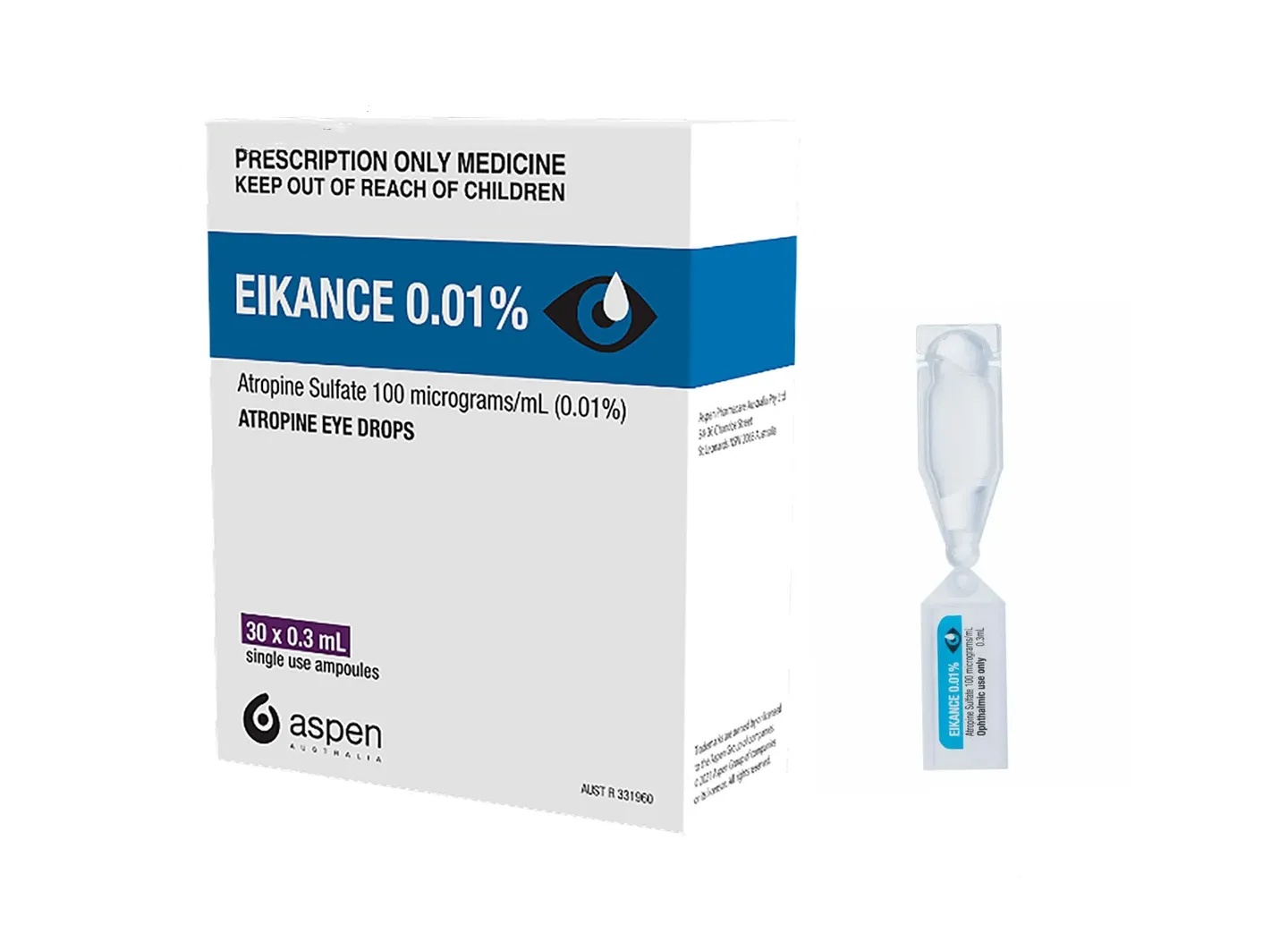
3. Usage and medication suggestions
The standard usage of EIKANCE is to instill 1 drop into each eye before going to bed every night. After application, close your eyes and rest for 1 to 2 minutes. Avoid rubbing your eyes or blinking to reduce the outflow of the medicine. When instilling eye drops, keep the tip of the dropper bottle away from your eyes or eyelashes to prevent contamination of the solution.
Before officially starting medication, it is recommended that an ophthalmologist conduct a comprehensive examination such as axial length, refractive status, and intraocular pressure to rule out other eye diseases that are not suitable for atropine use (such as glaucoma, severe dry eye, etc.). The initial period of dripping can be 1 week, 1 month, 3 months Review every month, and then every 3 to 6 months according to the doctor’s recommendations, and closely monitor the development of myopia and possible adverse reactions.
Things to note include:
Avoid exposure to strong light immediately after taking the medication, and it is recommended that children wear glasses with appropriate UV protection during the day;
If a drop is accidentally leaked, the drop can be replenished in time that night. Do not increase the dose the next day due to leakage;
If redness, eye pain, headache, worsening of photophobia, blurred vision, etc. occur during medication, the medication should be stopped in time and seek medical attention;
Do not stop taking the medicine at will during use. It is generally recommended that the course of treatment should not be less than 1 to 2 years. A professional doctor will decide whether to stop taking the medicine or reduce the dosage.
4. Frequently Asked Questions and Practical Suggestions
1. Will using EIKANCE affect learning?
No. 0.01% Atropine will basically not affect the adjustment function. Children can still read and study normally. A very small number of people will feel slightly unclear in reading in the early stage, which is mostly temporary.
2. Is it suitable for all myopic children?
Not exactly. EIKANCE is mainly used for 6 to 14Children who are years old and whose average annual myopia growth exceeds 0.5D, especially those with a family history or a tendency to develop rapidly. Children with mild hyperopia or pseudomyopia do not need to use it, and children with normal vision are not recommended to use it blindly.
3. Will it rebound after stopping the drug?
Research has shown that 0.01%The rebound effect of atropine on drug withdrawal is significantly reduced at higher concentrations, but continued observation is still required after drug withdrawal. It is generally recommended to gradually reduce the frequency of dosing, such as from daily use to every other day, and then to discontinuation.
4. Can it be used with orthokeratology lenses?
In some cases, doctors may recommend that patients with high-risk rapidly progressive myopia use EIKANCE in combination with orthokeratology lenses (OK lenses) to improve the control effect. However, whether to combine treatment needs to be evaluated by a professional ophthalmologist.
EIKANCE 0.01%Atropine Sulfate Eye Drops, as one of the current mainstream myopia prevention and control methods, has become the trusted choice of many parents due to its high safety, good compliance and significant efficacy. Its scientific medication methods and standardized management procedures can effectively help children control the progression of myopia and delay the risk of high myopia. Although this drug is easy to use, as a prescription drug, it should be used under the guidance of a professional doctor and subject to long-term follow-up management to achieve the best therapeutic effect and medication safety. For families looking to protect their children's vision in the long term, EIKANCE is a reasonable option worth considering.
Reference materials:https://www.medsafe.govt.nz/profs/datasheet/e/EikanceEyeDrops.pdf
[ 免责声明 ] 本页面内容来自公开渠道(如FDA官网、Drugs官网、原研药厂官网等),仅供持有医疗专业资质的人员用于医学药学研究参考,不构成任何治疗建议或药品推荐。所涉药品可能未在中国大陆获批上市,不适用于中国境内销售和使用。如需治疗,请咨询正规医疗机构。本站不提供药品销售或代购服务。


