
.jpeg)
New immunotherapy Tarlatamab approved in Japan for treatment of refractory small cell lung cancer
In April 2025, Japan officially approved an innovative immune drug, tarlatumab (Tarlatamab, trade name IMDELLTRA) is marketed for the treatment of adult patients with small cell lung cancer (SCLC) whose disease has progressed despite chemotherapy. This "first-in-class" bispecific T cell connector (BiTE) drug developed by Amgen (Amgen) is an important new breakthrough in the treatment of small cell lung cancer. Previously, the drug had received accelerated approval from the U.S. FDA in May 2024, and has obtained marketing authorization in many countries and regions, including Canada, Brazil, Israel, the United Kingdom, Hong Kong, and Taiwan.
The mechanism of IMDELLTRA is very unique. It targets T CD3 on T cells and on the surface of tumor cells at the same time. pan>DLL3 protein, thereby activating T cells to form cytotoxic synapses, effectively eliminating cancer cells expressing DLL3. DLL3 is a protein that is highly expressed in the tumor cells of most patients with small cell lung cancer (about 85%-96% ) but rarely expressed in normal tissues, making it an ideal target marker. This precise positioning method significantly improves the pertinence of treatment and reduces the risk of damage to normal cells.
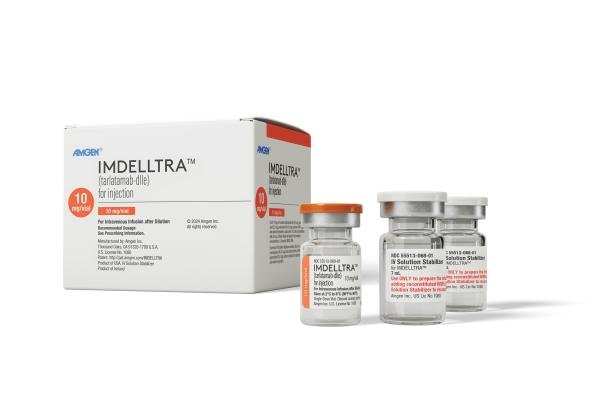
IMDELLTRA was approved based on a pivotal clinical trial calledDeLLphi-301. The study was a multicenter, open-label, multi-cohort study that included 99 patients with extensive-stage small cell lung cancer whose disease progressed despite platinum-based chemotherapy. The results showed that the overall response rate (ORR) was 40%. Of the 69 patients with platinum sensitivity data, 27The response rate of platinum-resistant patients was 52%, while the response rate of 42 platinum-sensitive patients was 31%. The median response duration of patients after treatment was 9.7 months, and the median overall survival was 14.3 months, showing good treatment prospects.
At the 2024 World Lung Cancer Conference, Amgen also announced the latest research results of IMDELLTRA in first-line maintenance therapy. Data show that the drug still maintains good safety when combined with PD-L1 inhibitors, and the disease control rate reaches 62.5%. In addition, combining IMDELLTRA with the immune checkpoint inhibitors Imfinzi (durvalumab) and Tecentriq< /span>(ateezolizumab) also showed a trend of prolonged survival when used in combination, with median progression-free survival of 5.3 months and 5.6 months respectively.
The latest announcement of the interim analysis of the Phase III study of DeLLphi-304 further confirmed the potential of IMDELLTRA in the treatment of extensive stage SCLC. This study shows that IMDELLTRA shows significant advantages in prolonging the overall survival of patients compared with traditional chemotherapy regimens, and is statistically and clinically significant. Its safety is also consistent with earlier studies, and no new uncontrollable adverse reactions have emerged.
To sum up, IMDELLTRA, as a new immunotherapy targeting DLL3, not only achieves positive results in the treatment of relapsed and refractory small cell lung cancer, but also provides a new treatment direction for patients with this disease, indicating that the field of small cell lung cancer treatment is ushering in important technological innovations. In the future, with the accumulation of more clinical data, the drug is expected to further expand its indications globally and benefit more lung cancer patients.
[ 免责声明 ] 本页面内容来自公开渠道(如FDA官网、Drugs官网、原研药厂官网等),仅供持有医疗专业资质的人员用于医学药学研究参考,不构成任何治疗建议或药品推荐。所涉药品可能未在中国大陆获批上市,不适用于中国境内销售和使用。如需治疗,请咨询正规医疗机构。本站不提供药品销售或代购服务。


