
.jpeg)
Qfitlia (Fitusiran): FDA approves new treatment for hemophilia A or B with or without factor inhibitors
On March 28, 2025, the U.S. Food and Drug Administration (FDA) approved Qfitlia (Fitusiran) for routine prophylaxis to prevent or reduce the frequency of bleeding events in adult and pediatric patients 12 years of age and older with hemophilia A or B, with or without factor VIII or IX inhibitors (neutralizing antibodies).
HemophiliaHemophilia A and hemophilia B are hereditary bleeding disorders caused by dysfunction or deficiency of clotting factor VIII (FVIII) or IX (FIX) respectively. These people with hemophilia are unable to clot their blood properly and may bleed for longer than normal after an injury or surgery. They may also experience spontaneous bleeding in their muscles, joints, and organs, which can be life-threatening. These bleeding events are typically managed with on-demand, episodic treatment, or prophylaxis with products containing FVIII or FIX or factor-mimicking products.
Qfitlia does not replace missing clotting factors. Instead, it reduces the amount of a protein called antithrombin, leading to an increase in thrombin, an enzyme critical for blood clotting.
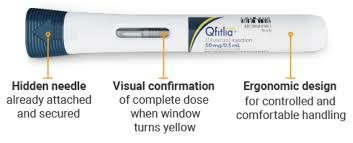
Qfitlia is started as a subcutaneous injection every two months. Adjust injection dose and frequency using the FDA-approved INNOVANCE antithrombin companion diagnostic test. The companion diagnostic is designed to monitor and achieve target ranges of antithrombin activity by informing injection dose and frequency to reduce the risk of bleeding and excessive coagulation. The U.S. Food and Drug Administration has approved Siemens Healthcare Diagnostics’ INNOVANCE antithrombin test.
The efficacy and safety of Qfitlia were evaluated in two multicenter, randomized clinical trials that enrolled a total of 177 adult and pediatric male patients with hemophilia A or hemophilia B. In one study, participants had inhibitory antibodies to FVIII or FIX and had received an on-demand bleeding drug "bypass agent." In the second study, participants did not have inhibitory antibodies to FVIII or FIX and had previously received on-demand treatment with clotting factor concentrates. In both randomized trials, participants received either a fixed dose of Qfitlia every month or regular on-demand treatment (bypassing medications or clotting factor concentrates) as needed for nine months. Qfitlia is not approved in fixed doses because it can cause excessive clotting in some patients.
The primary measure of Qfitlia's efficacy is the estimated annual rate of bleeding treated. Among inhibitor participants who received the antithrombin-based dosing regimen of Qfitlia, the estimated annual bleeding rate was reduced by 73% compared with participants who received on-demand bypass therapy. Among participants who received the Qfitlia antithrombin dosing regimen without inhibitors, the estimated annual bleeding rate was reduced by 71% compared with participants who received on-demand clotting factor concentrates.
Qfitlia has boxed warnings for thrombotic events (blood clotting) and gallbladder disease (some patients require gallbladder removal). Qfitlia also carries a warning about liver toxicity, requiring monitoring of liver blood tests at baseline and then monthly for at least six months after starting treatment with Qfitlia or increasing the dose of Qfitlia. The most common side effects of Qfitlia are viral infections, common cold symptoms (nasopharyngitis), and bacterial infections.
References:https://www.fda.gov/news-events/press-announcements/fda-approves-novel-treatment-hemophilia-or-b-or-without-factor-inhibitors
[ 免责声明 ] 本页面内容来自公开渠道(如FDA官网、Drugs官网、原研药厂官网等),仅供持有医疗专业资质的人员用于医学药学研究参考,不构成任何治疗建议或药品推荐。所涉药品可能未在中国大陆获批上市,不适用于中国境内销售和使用。如需治疗,请咨询正规医疗机构。本站不提供药品销售或代购服务。


