
.jpeg)
Avtozma (tocilizumab-anoh) instruction manual in Chinese
1. Name:Avtozma, tocilizumab-anoh
2. Indications:
Avtozma (tocilizumab-anoh) is indicated to treat the following conditions:
1. Rheumatoid Arthritis (RA): It is suitable for the treatment of adult patients with moderately to severely active RA who have poor response to one or more disease-modifying antirheumatic drugs (DMARDs).
2. Giant cell arteritis (GCA): Suitable for the treatment of GCA in adult patients.
3. Polyarticular juvenile idiopathic arthritis (PJIA): It is suitable for the treatment of active PJIA patients aged 2 years and above.
4. Systemic juvenile idiopathic arthritis (SJIA): It is suitable for the treatment of active systemic SJIA patients 2 years old and above.
5. Coronavirus Disease2019 (COVID-19): Applicable to the treatment of coronavirus disease 2019 in hospitalized adult patients who are receiving systemic corticosteroids and require supplemental oxygen, non-invasive or invasive mechanical ventilation, or extracorporeal membrane oxygenation (extracorporeal membrane oxygenation).
3. Usage and dosage:
1. Medication management:
(1) It is not recommended to use Avtozma concurrently with biological DMARDs; due to the possibility of increased immunosuppression and increased risk of infection, tocilizumab products have not been studied in combination with biological DMARDs such as TNF antagonists, IL-1R antagonists, anti-CD20 monoclonal antibodies, and selective costimulation modulators. Avoid using Avtozma with biologic DMARDs.
(2) Baseline laboratory evaluation before treatment: Obtain and evaluate a baseline complete blood count (CBC) and liver function tests before treatment. RA, GCA, PJIA, and PJIA recommend that patients with an absolute neutrophil count (ANC) less than 2,000/mm3, a platelet count less than 100,000/mm3, or an ALT or AST greater than 1.5 times the upper limit of normal (ULN) should not use Avtozma. COVID-19—It is recommended that patients with an absolute neutrophil count (ANC) less than 1,000/mm3, a platelet count less than 50,000 mm3, or an ALT or AST greater than 10 times the ULN should not use Avtozma.
2. Recommended dosage:
(1) Rheumatoid Arthritis (RA): The recommended intravenous dose of Avtozma for treatment of adults is 4 mg per kilogram every 4 weeks, then increased based on clinical response to 8 mg per kilogram every 4 weeks. The recommended subcutaneous dosing regimen for the treatment of RA patients weighing <100 kg is 162 mg subcutaneously every other week, increasing to once weekly based on clinical response. The dose for patients weighing 100 kg or more is 162 mg subcutaneously weekly.
(2) Giant cell arteritis (GCA): The recommended intravenous dose of Avtozma in adult patients is a single 60-minute intravenous infusion of 6 mg/kg every 4 weeks, combined with a tapering course of glucocorticoids. For adult patients with GCA, the recommended subcutaneous dose is 162 mg administered subcutaneously once weekly in combination with tapering courses of glucocorticoids.
(3) Polyarticular juvenile idiopathic arthritis (PJIA): For patients weighing <30kg, the recommended intravenous dose is 10mg/kg, once every 4 weeks, as a 60-minute intravenous infusion. The dose for patients weighing 30 kg or more is 8 mg per kilogram. The recommended subcutaneous dosage regimen for PJIA patients weighing <30 kg is 162 mg every 3 weeks. The dose for patients weighing 30 kg or more is 162 mg every two weeks.
(4) Systemic juvenile idiopathic arthritis (SJIA): For patients weighing <30kg, the recommended intravenous dose is 12mg/kg, once every 2 weeks, as a single intravenous infusion over 60 minutes. The dose for patients weighing 30 kg or more is 8 mg per kilogram. The recommended subcutaneous dosage regimen for SJIA patients weighing <30 kg is 162 mg every 2 weeks. The dose for patients weighing 30 kg or more is 162 mg once weekly.
(5) COVID-19: The recommended dose of Avtozma for the treatment of adult patients is 8 mg/kg, a single 60-minute intravenous infusion. If clinical signs or symptoms worsen or do not improve after the first dose, another infusion of Avtozma may be given at least 8 hours after the first infusion.
4. Adverse reactions:
In clinical studies of Avtozmacommon adverse reactions include upper respiratory tract infection, nasopharyngitis, headache, hypertension, increased alanine aminotransferase (ALT) and injection site reactions (redness, swelling, pain, rash, etc.). Anaphylaxis (fatal anaphylaxis, Stevens-Johnson syndrome, drug reaction with eosinophilia and systemic symptoms [dressing]), pancreatitis, drug-induced liver injury, hepatitis, liver failure, jaundice, etc. have also occurred after the drug was put on the market.
5. Supply and storage:
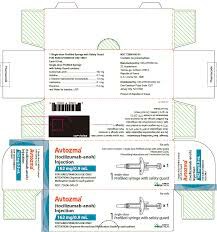
Avtozma Injection is a preservative-free, sterile, clear to slightly opalescent, colorless to pale yellow intravenous infusion solution packaged in single-dose vials in cartons with the following strengths and packaging configurations: 80mg/4mL (20mg/mL), 200m g/10mL (20mg/mL), 400mg/20mL (20mg/mL); it is also a preservative-free, sterile, clear to slightly opalescent, colorless to yellow subcutaneous injection, each single-dose prefilled syringe delivers 162mg/0.9mL.
Do not use product in containers, packaging, prefilled syringes, or auto-injectors beyond the expiration date. Avtozma must be refrigerated at 36°F to 46°F (2°C to 8°C). Do not freeze. Until use, store vials, syringes, and auto-injectors in their original cartons to protect them from light and keep syringes and auto-injectors dry. Prefilled syringes and auto-injectors can be stored at room temperature of 77°F (25°C) or lower for up to 3 weeks after removal from the refrigerator. Prefilled syringes and auto-injectors must always be kept in their cartons.
6. Taboo:
Avtozma is contraindicated in patients with known hypersensitivity to tocilizumab productsAvtozma.
7. Mechanism of action:
Tocilizumab products bind to soluble and membrane-bound IL-6 receptors (sIL-6R and mIL-6R) and have been shown to inhibit IL-6-mediated signaling through these receptors. IL-6 is a pleiotropic pro-inflammatory cytokine produced by multiple cell types, including T and B cells, lymphocytes, monocytes, and fibroblasts. IL-6 has been shown to be involved in a variety of physiological processes, such as T cell activation, induction of immunoglobulin secretion, initiation of acute phase protein synthesis in the liver, and stimulation of hematopoietic precursor cell proliferation and differentiation. Synoviocytes and endothelial cells also produce IL-6, leading to local production of IL-6 in joints affected by inflammatory processes such as rheumatoid arthritis.
8. Notes:
Warnings and precautions related toAvtozma include: serious infection, gastrointestinal perforation, hepatotoxicity, laboratory abnormalities and allergic reactions, and the use of live vaccines should be avoided.
Reference materials:https://dailymed.nlm.nih.gov/dailymed/drugInfo.cfm?setid=581c288f-8015-40ef-a4c3-683c96db193d
[ 免责声明 ] 本页面内容来自公开渠道(如FDA官网、Drugs官网、原研药厂官网等),仅供持有医疗专业资质的人员用于医学药学研究参考,不构成任何治疗建议或药品推荐。所涉药品可能未在中国大陆获批上市,不适用于中国境内销售和使用。如需治疗,请咨询正规医疗机构。本站不提供药品销售或代购服务。


