
.jpeg)
Real-world efficacy and safety of trastuzumab vs. trastuzumab and tucatinib as second- and third-line treatments for HER2-positive metastatic breast cancer
The treatment of HER2-positive metastatic breast cancer (HER2+mBC) has developed rapidly in recent years, and new targeted therapeutic drugs are constantly emerging. Trastuzumab (T-DXd), trastuzumab (T-DM1) and tucatinib/tucatinib (Tucatinib) are currently the main treatment options for patients with HER2+mBC. This study aims to evaluate the real efficacy and safety of T-DXd and T-DM1 and T-DXd and tucatinib by simulating two phase III clinical trials, with a view to providing a reference for clinical practice.
This study used the French National Health Data System for simulation analysis, focusing on the efficacy and safety of HER2+mBC patients in second-line and third-line treatment. We included patient data from September 2020 to September 2023 and followed patient survival until April 2024. We simulated the randomization process for treatment assignment through an inverse probability approach to treatment weighting. Efficacy evaluation mainly includes treatment time to discontinuation (TTD) and overall survival (OS), while safety evaluation focuses on hospitalization due to specific causes.
In the simulation of second-line treatment, a total of 2931 patients were included, of whom 1633 received T-DM1 and 1298 received T-DXd. The results showed that the median TTD of T-DXd was 14.1 months, which was significantly higher than that of T-DM1 of 6.5 months (hazard ratio wHR was 0.46, 95% confidence interval was 0.42–0.51). In terms of overall survival, the median OS of T-DXd was not reached, while that of T-DM1 was 12.5 months, and the wHR was 0.66 (95% CI: 0.55–0.80), showing the superiority of T-DXd in efficacy. However, it should be noted that more cases of interstitial lung disease were observed in the T-DXd group.
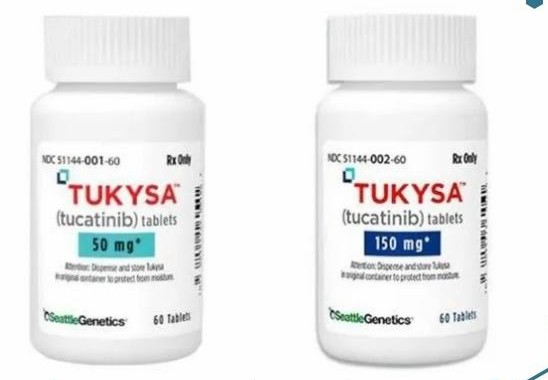
In the simulation of third-line treatment, a total of 2391 patients were included, of which 566 received tucatinib and 1825 received T-DXd. The median TTD in the T-DXd group was 11.8 months, which was significantly longer than that of tucatinib (5.8 months) (wHR 0.60, 95% CI 0.53-0.68). In terms of overall survival, the median OS in the T-DXd group was 31.7 months, compared with tucatinib.At 26.6 months, wHR was 0.79 (95% CI, 0.69–0.92). This suggests that T-DXd is also superior to tucatinib in third-line treatment.
Safety assessment shows that T-DXd shows a certain protective effect on the incidence of heart disease (wHR is 0.44, 95%CI is 0.26-0.74), but at the same time increases the risk of respiratory diseases (wHR is 1.72, 95%CI is 1.03-2.89), which requires attention in clinical application.
The results of this study show that trastuzumab is more effective than trastuzumab and tucatinib in the second-line and third-line treatment of HER2-positive metastatic breast cancer, especially in terms of treatment withdrawal time and overall survival. However, the safety issues of T-DXd also remind us that we need to carefully monitor the lung and heart health of patients during clinical use. These findings provide important basis for the clinical treatment of HER2-positive metastatic breast cancer.
Reference materials:https://www.epi-phare.fr/en/study-reports-and-publications/efficacite-securite-trastuzumab-deruxtecan/
[ 免责声明 ] 本页面内容来自公开渠道(如FDA官网、Drugs官网、原研药厂官网等),仅供持有医疗专业资质的人员用于医学药学研究参考,不构成任何治疗建议或药品推荐。所涉药品可能未在中国大陆获批上市,不适用于中国境内销售和使用。如需治疗,请咨询正规医疗机构。本站不提供药品销售或代购服务。


