.jpeg)
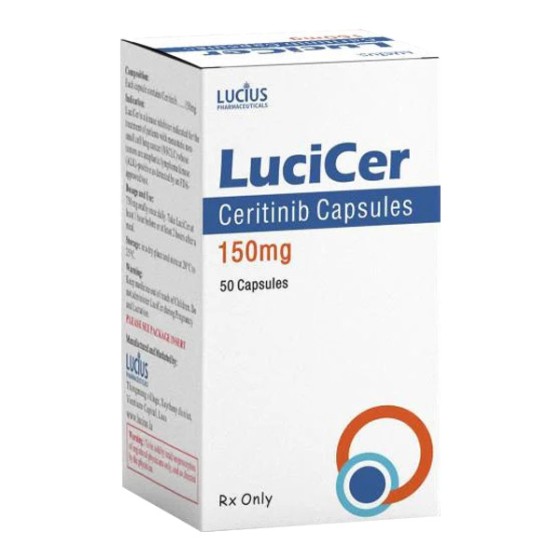
Ceritinib for ALK-Positive NSCLC: Indication, Dosing, and Safety Management
1.Position and Eligible Patients
Ceritinib inhibits abnormal ALK signaling to reduce tumor-cell proliferation and survival.It is intended for adults with locally advanced or metastatic NSCLC confirmed to have ALK rearrangement/fusion by a validated assay.Patients without a corresponding ALK driver are not appropriate candidates for ceritinib as routine targeted therapy.Whether to use it first-line,after prior ALK inhibitors,or as part of another sequence depends on prior treatment,CNS disease,tolerability,and the overall plan.
2.Administration and Dosing
Standard dosing is 450mg orally once daily at the same time,with food;swallow capsules whole and do not substitute broken contents for stated strengths.Continue until disease progression or unacceptable toxicity.If a dose is missed and more than 12 hours remain before the next dose,take it;if less than 12 hours remain,skip and resume the regular schedule.Do not replace a dose after vomiting;take the next scheduled dose.
For toxicity-driven reduction,decrease in 150mg steps,for example 450mg→300mg→150mg once daily.After standard supportive care,if 150mg once daily with food remains intolerable,discontinue.All changes are made by oncology based on adverse-event grade,hepatic/renal function,and concomitant drugs.
3.Baseline and Ongoing Monitoring
Baseline:ALK report,CBC,LFTs(ALT,AST,total bilirubin),fasting glucose,electrolytes,ECG;amylase/lipase,renal function,and imaging as needed.
During therapy:LFTs more frequently early and then per protocol;glucose per clinical indication;assess dehydration and electrolytes with diarrhea/nausea;repeat ECG for QT risk and pulse for bradycardia.
Imaging:reassess thoracic and other involved sites at treatment milestones rather than relying on symptoms alone.
4.Key Adverse Events and Stop Rules
Gastrointestinal:diarrhea,nausea,vomiting,abdominal pain,anorexia.Use food,antidiarrheals/antiemetics,fluids;with severe or persistent symptoms,hold and restart at a 150mg-lower dose after improvement.
Hepatotoxicity:ALT/AST>5×ULN with total bilirubin≤2×ULN—hold until≤3×ULN or baseline,then restart at a lower dose;ALT/AST>3×ULN with total bilirubin>2×ULN without cholestasis/hemolysis—consider permanent discontinuation.
ILD/noninfectious pneumonitis:suspect any new cough,dyspnea,or infiltrates;hold and image.If treatment-related,discontinue permanently.
Hyperglycemia:baseline and periodic glucose;optimize antihyperglyrics.Persistent>250mg/dL despite optimal care—hold and restart at a lower dose;if uncontrolled medically,discontinue.
QT prolongation:two separate ECGs with QTc>500ms—hold,resume at a lower dose once QTc<481ms or back to baseline;torsade,polymorphic VT,or serious arrhythmic signs—permanent stop.
Bradycardia:symptomatic episodes—hold,resume when asymptomatic or heart rate≥60bpm,review concomitant bradycardic drugs;if another drug is responsible and adjusted,restart at prior dose,otherwise restart at a reduced dose.
Pancreas:marked amylase/lipase with abdominal pain warrants pancreatitis evaluation,holding therapy and specialist input.
5.Interactions and Special Notes
Avoid strong CYP3A inhibitors such as certain azole antifungals and ritonavir-class drugs;if unavoidable,reduce ceritinib by about one-third to the nearest 150mg multiple and restore the prior dose after stopping the inhibitor.Strong CYP3A inducers such as rifampin may lower exposure and should generally be avoided.P-gp inhibitors can raise ceritinib levels;monitor toxicity.Avoid grapefruit/grapefruit juice.Severe hepatic impairment needs dedicated dose reduction;severe renal impairment has limited data and requires individualized handling.
[ 免责声明 ] 本页面内容来自公开渠道(如FDA官网、Drugs官网、原研药厂官网等),仅供持有医疗专业资质的人员用于医学药学研究参考,不构成任何治疗建议或药品推荐。所涉药品可能未在中国大陆获批上市,不适用于中国境内销售和使用。如需治疗,请咨询正规医疗机构。本站不提供药品销售或代购服务。