.jpeg)
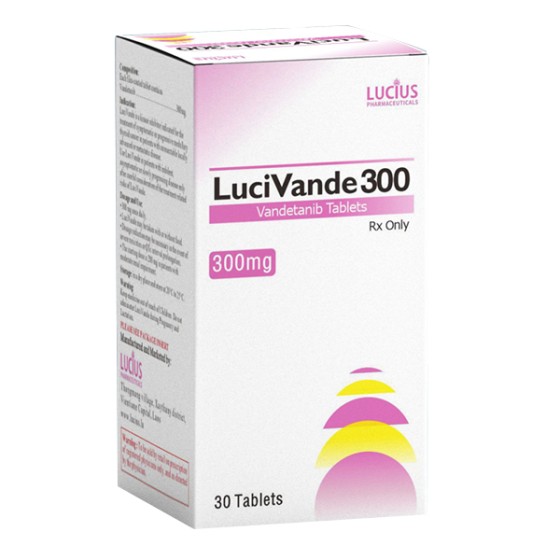
Vandetanib (Caprelsa): An Oral Multi-Target Agent for Progressive Medullary Thyroid Cancer
Which thyroid cancer it actually treats
The approved scope is narrow:unresectable locally advanced or metastatic medullary thyroid cancerin patients who are symptomatic or show radiographic progression.For indolent,asymptomatic or slowly progressing disease,the label explicitly requires that treatment-related risks be weighed carefully before initiating.
Boundary to remember:medullary thyroid cancer≠all thyroid cancers.Papillary,follicular and anaplastic thyroid carcinoma are outside this indication;vandetanib is not a pan-thyroid-cancer targeted agent.
Why the multi-target profile matters in MTC
Vandetanib simultaneously inhibits three receptor tyrosine kinases:
RET—a core driver in MTC;inhibition cuts the main proliferative signal
VEGFR—limits tumour angiogenesis and nutrient supply
EGFR—blocks a parallel growth pathway
This"one molecule,three pathways"design is the pharmacological basis for its activity in MTC.It is,however,a multikinaserather than a highly selective RET inhibitor,and the off-target activity is also the source of its toxicity.Highly selective RET inhibitors(e.g.selpercatinib)have since shown superior PFS versus vandetanib/cabozantinib in head-to-head comparison,which places vandetanib further down the contemporary treatment sequence.
Can it be used in other tumours?
Vandetanib has been studied in non–small cell lung cancer and other solid tumours,but investigational use is not an approved indication.The core FDA indication remains medullary thyroid cancer only;any use outside that label falls under off-label or research pathways and should not be presented as routine therapy.
The safety red line:QT prolongation
This is the toxicity that demands active management,with risk of torsades de pointes and sudden death if mishandled.
Standard dosing
300 mg orally once daily,with or without food
If a dose is missed and<12 h remain before the next,skip it
Patients with swallowing difficulty may disperse the tablet in non-carbonated water;do not crush
Reduction and interruption rules
QTcF>500 ms:interrupt until<450 ms,then resume at a reduced dose
CTCAE grade≥3 toxicity:interrupt until≤grade 1,then reduce
Dose ladder:300 mg→200 mg→100 mg
Moderate to severe renal impairment:start at 200 mg
Half-life≈19 days—adverse effects,including QT prolongation,resolve slowly;allow a wide monitoring window
Monitoring schedule
Baseline,2–4 weeksand 8–12 weeksafter starting,then every 3 months:ECG plus serum potassium,calcium,magnesium
Increase electrolyte and ECG frequency during diarrhoea
Keep K⁺≥4 mEq/L;keep Ca²⁺and Mg²⁺within normal range
Avoid concomitant QT-prolonging drugs;if unavoidable,intensify ECG monitoring
Most common adverse reactions:diarrhoea,rash,nausea,hypertension—generally manageable with supportive care and dose modification.
[ 免责声明 ] 本页面内容来自公开渠道(如FDA官网、Drugs官网、原研药厂官网等),仅供持有医疗专业资质的人员用于医学药学研究参考,不构成任何治疗建议或药品推荐。所涉药品可能未在中国大陆获批上市,不适用于中国境内销售和使用。如需治疗,请咨询正规医疗机构。本站不提供药品销售或代购服务。