
.jpeg)
Detailed Chinese instructions and medication guide for Enasidenib
1. Common names: Ensidipine (Enasidenib), Idhifa, Enasidenib mesylate
Enasidenib is a new type of targeted drug mainly used to treat specific types of acute myeloid leukemia (AML) . As an inhibitor of isocitrate dehydrogenase 2 (IDH2) , it can effectively target tumor cells carrying IDH2 mutations, providing a new treatment option, especially when traditional treatments are ineffective.
2. Indications
The indications of ensidipine are mainly for adult patients with relapsed or refractory (R/R) acute myeloid leukemia. Such patients often remain at risk of disease progression despite multiple treatments. The presence of IDH2 gene mutations is closely related to the occurrence of various hematological tumors, so the use of ensidipine can significantly improve the prognosis of these patients.
3. Usage and dosage
Before using ensidipine, doctors need to conduct a comprehensive evaluation to determine whether the patient has an IDH2 mutation. Testing for mutations usually requires verification with a blood or bone marrow biopsy. In addition, during drug treatment, doctors need to regularly monitor the patient's blood cell count and blood chemistry indicators in order to promptly detect and deal with possible complications such as leukocytosis or tumor lysis syndrome.
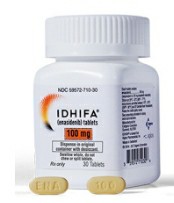
The recommended dose of ensidipine is 100 mg once daily. Patients can choose to take it orally before or after meals. Treatment should be continued until disease progression or unacceptable toxicity occurs. In the absence of disease progression or unacceptable toxicity, patients are recommended to receive treatment for at least 6 months to allow for observation of a potential clinical response.
4. Adverse reactions
The use of ensidipine may be associated with some adverse effects. According to clinical studies, the most common adverse reactions include increased total bilirubin, decreased calcium, nausea, diarrhea, decreased potassium, vomiting, decreased appetite, and decreased phosphorus. In particular, the increase and decrease in total bilirubin and potassium may pose a potential threat to the patient's health.
5. Storage
Ensidipine requires strict storage conditions. Medications should be stored within a temperature range of 20°C-25°C (68°F-77°F), with a permitted temperature deviation of 15°C-30°C (59°F-86°F). In order to maintain the effectiveness of the medicine, the bottle cap must be kept tightly closed and stored in the original bottle. Cans with desiccant can effectively prevent the medicine from getting damp.
6. Mechanism of action
Ensidipine exerts its anti-tumor effects by selectively inhibiting isocitrate dehydrogenase2 (IDH2). The drug is able to effectively target mutant IDH2 variants (such as R140Q, R172S and R172K) in vitro at significantly lower concentrations than the wild-type enzyme. In a mouse xenograft model, ensidipine administration showed that inhibition of the mutant IDH2 enzyme significantly reduced 2-hydroxyglutarate (2-HG) levels, thereby promoting normal bone marrow differentiation.
In clinical practice, ensidipine has been shown to be effective in reducing 2-HG levels, reducing osteoblast counts, and increasing the percentage of mature myeloid cells in patients with IDH2 mutations. This mechanism provides a scientific basis for the treatment of acute myeloid leukemia related to IDH2 mutations, and also opens up a new direction for future research and new drug development.
Reference materials:https://www.idhifa.com/
[ 免责声明 ] 本页面内容来自公开渠道(如FDA官网、Drugs官网、原研药厂官网等),仅供持有医疗专业资质的人员用于医学药学研究参考,不构成任何治疗建议或药品推荐。所涉药品可能未在中国大陆获批上市,不适用于中国境内销售和使用。如需治疗,请咨询正规医疗机构。本站不提供药品销售或代购服务。


