
.jpeg)
Detailed pharmacology, usage and dosage in Entrectinib instructions
Entrectinib is an oral multi-target tyrosine kinase inhibitor that mainly targets three fusion proteins: TRK (NTRK1/2/3), ROS1 and ALK. Its mechanism of action is to block the proliferation and survival signals of tumor cells by inhibiting the tyrosine kinase activity activated by these fusion genes. Especially in NTRKfusion-positive solid tumors and ROS1fusion-positive non-small cell lung cancer (NSCLC), entrectinib shows broad-spectrum and efficient anti-tumor activity, has strong central nervous system penetration, and has a significant effect on brain metastases.
According to the instructions and clinical trial results, entrectinib is approved for use in two categories of patients: one is patients with locally advanced or metastatic solid tumors with NTRK fusion genes and no effective alternative treatment options; the other is patients with ROS1 fusion-positive metastatic non-small cell lung cancer. It is worth mentioning that entrectinib, as a "tissue-independent" targeted therapy drug, is applicable to NTRK fusion-positive patients in a variety of tumor types (such as lung cancer, soft tissue sarcoma, thyroid cancer, etc.), thus providing a new way of precise treatment for people with rare mutations.
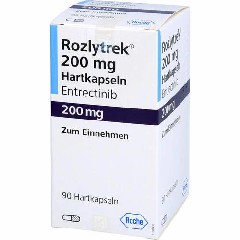
The recommended oral dosage for adult patients is 600 mg once daily, which can be taken on an empty stomach or with food. It is not recommended to chew or crush the tablets. The recommended dose for children and adolescents (12 years and above) is calculated based on body surface area (BSA), usually once a day, and the dose range is 300mg~600mg, which is determined by the doctor after evaluation. If the patient experiences serious adverse reactions, the dose can be adjusted according to the recommendations in the instructions, such as 400mg, 200mg and other stepwise reductions. During medication, you should avoid using strong inhibitors or inducers of CYP3A4 at the same time to avoid affecting the efficacy or increasing toxicity.
Enrectinib is well absorbed in the body. The peak time in plasma is about 4~6 hours. It is mainly metabolized by CYP3A4 and its elimination half-life is about 20 hours, steady-state plasma concentration is usually reached in about 1 weeks of continuous medication. Due to its wide distribution and good brain tissue penetration, it is particularly suitable for patients with concomitant brain metastases. The instructions recommend that NTRK or ROS1 gene testing be performed before treatment to confirm indications, and liver function, electrolytes and electrocardiograms should be monitored regularly, and side effects such as QT interval prolongation, anemia, and elevated liver enzymes should be alerted, and dosage adjustments or treatment suspension should be made if necessary.
Reference materials:https://www.drugs.com
[ 免责声明 ] 本页面内容来自公开渠道(如FDA官网、Drugs官网、原研药厂官网等),仅供持有医疗专业资质的人员用于医学药学研究参考,不构成任何治疗建议或药品推荐。所涉药品可能未在中国大陆获批上市,不适用于中国境内销售和使用。如需治疗,请咨询正规医疗机构。本站不提供药品销售或代购服务。


