
.jpeg)
In the Phase 3 QuANTUM-Wild Trial of Quizartinib in Newly Diagnosed FLT3-ITD-Negative Acute Myeloid Leukemia
Quizartinib (Quizartinib)Phase 3 QuANTUM in patients with newly diagnosedFLT3-ITD-negativeacute myeloid leukemia Wild) trial is ongoing, an exciting study designed to evaluate whether the drug combined with chemotherapy can extend overall survival (OS) in these patients. Although the prognosis of FLT3-ITD-positive patients is relatively poor and the survival of FLT3 wild-type patients is relatively good, further improvements and innovative treatment strategies are still needed.
The background of this study comes from the previousPhase 2 QUIWI trial (NCT04107727), which preliminary results showed that patients who received quizartinib combined with7+3 chemotherapy had a significant improvement in overall survival compared with patients who received placebo plus 7+3 chemotherapy alone. Specific data showed that patients treated with quizartinib reduced the risk of death by 37% (hazard ratio HR was 0.63, 95% confidence interval [CI] was 0.44-0.91, and two-sided P value was 0.0121). These data lay the foundation for the upcoming QuANTUM Wild trial and provide theoretical support for clinical application.
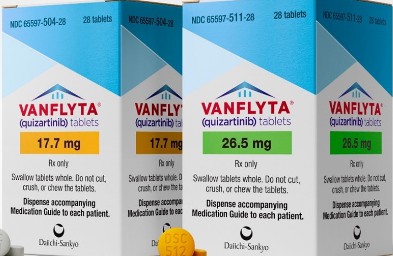
The QuANTUM Wild trial was designed to compare the efficacy of quizartinib plus chemotherapy versus placebo plus chemotherapy. Eligible patients will be randomly assigned into three groups: one group will receive a combination of quizartinib and 7+3 chemotherapy, followed by maintenance therapy with quizartinib; the second group will receive placebo and /span>combination therapy with 7+3 chemotherapy, entering maintenance treatment; the third group received quezartinib and 7+3 chemotherapy during the induction and consolidation periods, while a placebo was used during the maintenance phase. This design not only helps researchers evaluate the efficacy of quizartinib, but also ensures that comparisons between different treatment options are fair and reasonable.
In this study, overall survival rate was used as the primary endpoint and was the core indicator to evaluate the effect of treatment. In addition, the study also set some secondary endpoints, including event-free survival and duration of complete response (CR), relapse-free survival, CR rate, negative CR with minimal or measurable residual disease, and associated safety assessments. Olivia further emphasized that key exploratory endpoints include comprehensive CR rate, patient-reported outcomes, and assessment of biomarkers, which will provide an important basis for in-depth understanding of the drug's mechanism of action in specific patient groups.
To ensure the scientificity and validity of the trial, the study set a series of admission criteria. Participants must be between 18 and 70 years old and have an ECOG performance status of 0 to 2. The only permitted prior treatment for AML includes leukapheresis, which is used to treat hyperleukocytosis. In addition, patients with central nervous system leukemia can receive cranial radiotherapy, preventive intrathecal chemotherapy, and growth factor/cytokine support.
In December 2024, Daiichi Sankyo announced that the first patient had started taking related drugs in the QuANTUM Wild trial, marking the official launch of this important study. The expected target enrollment is 700 patients, and the initial completion of the study is expected to be June 2030. Through extensive global recruitment and rigorous trial design, the study is expected to generate important clinical data and provide more effective treatment options for patients with newly diagnosed FLT3-ITD-negative AML.
References:https://www.onclive.com/view/dr-olivia-on-the-phase-3-quantum-wild-trial-of-quizartinib-in-newly-diagnosed-flt3-itd-negative-aml
[ 免责声明 ] 本页面内容来自公开渠道(如FDA官网、Drugs官网、原研药厂官网等),仅供持有医疗专业资质的人员用于医学药学研究参考,不构成任何治疗建议或药品推荐。所涉药品可能未在中国大陆获批上市,不适用于中国境内销售和使用。如需治疗,请咨询正规医疗机构。本站不提供药品销售或代购服务。


