
.jpeg)
Key contents of the official instruction manual of EIKANCE 0.01% Atropine Sulfate Eye Drops, including usage, dosage and contraindications
0.01%Atropine sulfate eye drops are a very low-concentration atropine preparation, which is mainly used to control the progression of myopia in children. Atropine is a non-selective anticholinergic drug that delays the progression of myopia by inhibiting ciliary muscle hyperregulation and biological mechanisms that may be involved in axial growth. 0.01% is a commonly used and relatively safe low-concentration eye drop in clinical research. It has shown significant myopia growth delaying effects in multiple myopia control clinical trials around the world. At the same time, the incidence of side effects is higher and the concentration is much lower.
1. Indications and target groups
0.01%Atropine sulfate eye drops are mainly suitable for:
There is evidence that children with obvious myopia progression (the common age range is 6–12 years old, but it can be applied to older ages based on the judgment of a physician).
Children and adolescents whose refractive examination shows that the refractive power increases rapidly year by year (for example, myopia increases every year ≥0.5D).
In conjunction with life intervention (increasing outdoor activities and reducing close eye use) as part of the comprehensive management of myopia control .
This medicine is not used to correct vision (cannot replace glasses), but is used to slow down the progression of myopia and help reduce the risk of high myopia and related complications.
2. Usage and dosage
The official instructions stipulate the following standardized medication methods:
① Medication method
This product is an eye drop. You need to instill one drop in each eye (in the conjunctival sac above the cornea) before going to bed.
The optimal medication time is The same time period every day to facilitate the stability of blood concentration and physiological regulation.
② Typical dosage regimen
Standard dosage:0.01% Daily1 drop/one drop per eye
Most clinical studies currently use this dose as the baseline regimen for long-term myopia control.
This dose is sufficient to exert a myopia-suppressing effect in most children while maintaining tolerability.
③ Individualized adjustment
If a child develops obvious photophobia or weakened ciliary muscle regulation after taking the medication (such as obvious visual fatigue at close range), the medication can be temporarily discontinued or the frequency of medication can be adjusted under the guidance of a physician.
For serious adverse reactions (such as photosensitivity, difficulty in severe adjustment, etc.), it is necessary to evaluate whether to reduce the frequency or suspend the medication and return to the clinic in a timely manner.
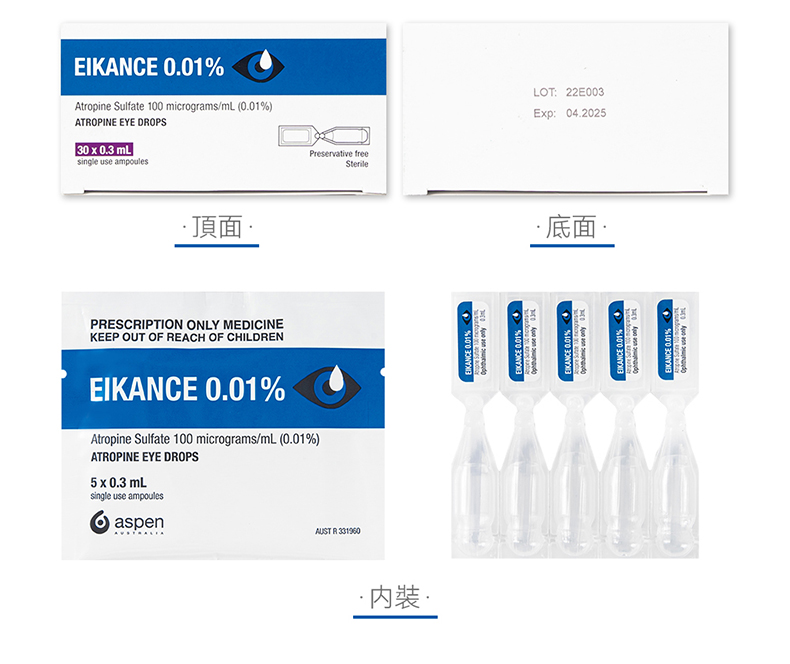
3. Pharmacological mechanism
Atropine is a typical anticholinergic agent. Its mechanism of action in myopia control mainly includes:
Suppress ciliary muscle accommodation response: Reduce accommodative excessive near use and reduce the stimulation of myopia axis growth caused by accommodative overload.
Possibly regulates retinal/Scleral signaling pathway: Basic research suggests that atropine may affect the axial growth factors released by the retina, thereby affecting axial lengthening.
Low concentration (0.01%) is characterized by mild and reversible effects on accommodation, weak effect on mydriasis, and extremely low systemic absorption.
Therefore, compared with traditional high-concentration atropine, low-concentration atropine is more suitable as a long-term myopia control drug.
4. Taboos and caution
The instructions specify the following contraindications and cautions:
① Taboo
Those with a known history of allergy to atropine sulfate or any excipients of this product.
This product cannot be used for other purposes or without a doctor's prescription.
② Use with caution
People who are at risk of glaucoma or angle-closure IOP elevation: Atropine can induce IOP elevation, and intraocular pressure and anterior segment structures need to be evaluated first.
Those with severe dry eyes, corneal lesions, eye infections or unstable ocular surface.
Those who have had strong reactions to anticholinergic drugs in the past, such as severe photophobia, dry mouth or general discomfort.
When used simultaneously with other topical ophthalmic drugs, interaction needs to be evaluated under the guidance of an ophthalmologist.
5. Possible side effects and monitoring
0.01%The side effects are generally less at the concentration, but you still need to be vigilant:
Local eye reactions: mild photophobia, fatigue at close vision after mydriasis, and occasional eye irritation.
Changes in optical accommodation: Some children may temporarily experience slow or weakened accommodation after taking this medication.
Systemic side effects are extremely rare: due to low concentration and local application, systemic absorption is small, but if systemic symptoms such as heart palpitations and allergies occur, you should seek medical treatment in time.
Regular follow-up should be carried out during use:
Refraction and axial length monitoring: Evaluate the efficacy every 3–6 months.
Intraocular pressure examination: especially for people at risk of glaucoma.
Assessment of vision accommodation ability: If there is obvious difficulty in near vision, assessment and adjustment should be made.
6. Medication discontinuation and evaluation
Instructions and guides suggest:
Medication usually requires a continuous long-term (1 or more years) evaluation cycle.
If the growth of myopia slows down (for example, the degree of myopia changes very little after 2 consecutive 2 reexaminations), you can discuss with your doctor about stopping the medication or entering an observation period.
It is necessary to closely monitor the progression of myopia after stopping the drug. Some studies have reported that a small amount of "rebound and deepening" may occur after stopping the drug. Therefore, discontinuation of the drug should also be reviewed step by step and regularly. Those who are at risk of rapid progression may need to restart treatment or use other methods to intervene.
7. Comprehensive management with other myopia interventions
The instructions emphasize that EIKANCE is not an independent curative drug, but a part of comprehensive myopia management and should be used in conjunction with:
Increase time spent outdoors
Control long-term use of eyes at close range
Correct glasses and visual function training
Regular eye exams
Comprehensive management can help improve long-term efficacy and reduce the risk of side effects.
Keyword tag:
Atropine Sulfate Eye Drops,EIKANCE, myopia control, children, reasons for discontinuation, precautions for discontinuation, deepening of rebound, gradual observation, daily behavior management
Reference materials:https://www.fda.gov/drugs
[ 免责声明 ] 本页面内容来自公开渠道(如FDA官网、Drugs官网、原研药厂官网等),仅供持有医疗专业资质的人员用于医学药学研究参考,不构成任何治疗建议或药品推荐。所涉药品可能未在中国大陆获批上市,不适用于中国境内销售和使用。如需治疗,请咨询正规医疗机构。本站不提供药品销售或代购服务。


