
.jpeg)
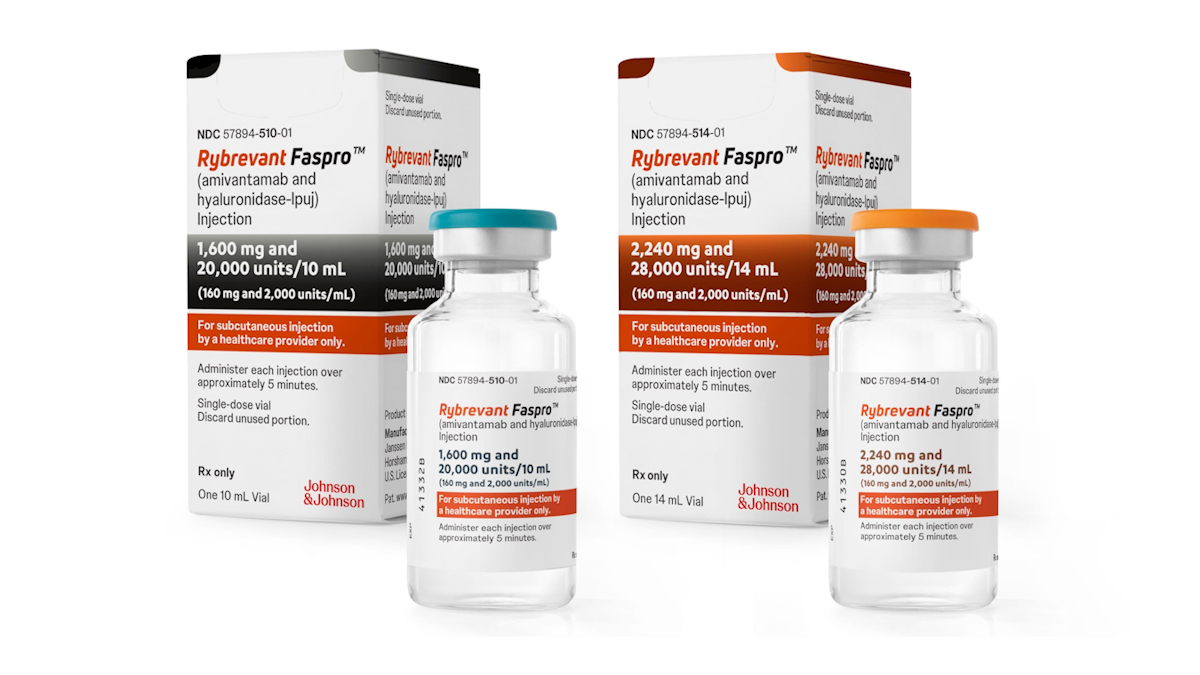
Instructions for subcutaneous injection of evantuzumab (Rybrevant Faspro) in Chinese
1. Generic name: amivantamab injection (subcutaneous injection), amivantamab and hyaluronidase-lpuj injection
Product name:Rybrevant Faspro, Rybrevant Faspro
Other names: subcutaneous evantuzumab, evantuzumab, and hyaluronidase
2. Who can use subcutaneous injection of evantumumab? Indications?
A combination of subcutaneous injections of Rybrevant Faspro (a bispecific EGF receptor-directed and MET receptor-directed antibody) and hyaluronidase (an endoglycosidase used to treat non-small cell lung cancer with mutations in the epidermal growth factor receptor) may be used in combination for the following conditions:
1. Use in combination with lanzetinib: For the first-line treatment of adult patients with locally advanced or metastatic non-small cell lung cancer (NSCLC) who have EGFR exon 19 deletion or exon 21 L858R substitution mutation, confirmed by an FDA-approved test.
2. Combined treatment with carboplatin and pemetrexed: For the treatment of adult patients with locally advanced or metastatic non-small cell lung cancer, provided that the patient has EGFR exon 19 deletion or 21 L858R mutation, and the disease has progressed after treatment with an EGFR tyrosine kinase inhibitor.
3. ForEGFR exon 20 insertion mutations: It can be used in first-line treatment in combination with carboplatin and pemetrexed, and is suitable for patients with locally advanced or metastatic non-small cell lung cancer confirmed by FDA-approved testing.
4. As monotherapy: When patients with locally advanced or metastatic non-small cell lung cancer progress during or after platinum-based chemotherapy and have EGFR exon 20 insertion mutations confirmed by FDA testing, evantumumab can be used for treatment.
3. What are the side effects of subcutaneous injection of evantumumab?
Inject evantumumab under the skinIn clinical studies, common adverse reactions (≥ 20%) in patients receiving combination therapy included rash, nail toxicity, musculoskeletal pain, fatigue, stomatitis, edema, nausea, diarrhea, vomiting, constipation, decreased appetite, and headache. Common grade 3 or 4 laboratory abnormalities (≥ 2%) include decreased lymphocyte count, decreased sodium, decreased potassium, decreased albumin, increased alanine aminotransferase, increased aspartate aminotransferase, decreased platelet count, increased gamma-glutamyl transferase, and decreased hemoglobin.
Warnings and precautions associated with it include allergic and dose-related reactions, interstitial lung disease(ILD)/pneumonitis, venous thromboembolic (VTE) events when used concomitantly with lanzitinib, serious adverse skin reactions, ocular toxicity, and embryo-fetal toxicity.
4. How to use subcutaneous injection of evantumumab
1. Administration method and recommended dosage: This drug is specially designed for subcutaneous use. The recommended injection site is the abdomen, and the injection time is about 5 minutes. Recommended doses are adjusted based on the patient's baseline weight, and relevant pretreatment medications should be considered before treatment.
1) Recommended dosage of combined carboplatin and pemetrexed (administered every 3 weeks):
For patients less than80kg, 1600 mg evantumumab + 20,000 units of hyaluronidase, or 2400 mg evantumumab + 30,000 units of hyaluronidase can be used at page The first dose is given on the 1st day of the 1st week, then once a week in the 2nd and 3rd weeks (2 doses in total), injection is given on the 1st day of each week, then once every 3 weeks starting from the 4th week.
For patients greater than or equal to80kg, 2240 mg evantumumab + 28,000 units of hyaluronidase, or 3360 mg evantumumab + 42,000 units of hyaluronidase can be used, at
If the patient's weight changes during subsequent treatment, dose adjustment is usually not necessary.
2) Recommended dosage when used in combination with lanzutinib or as a single agent (administered every 2 weeks):
For patients less than80kg, 1600mg evantumumab + 20000 units of hyaluronidase can be used.Once a week from the 1st week to the 4th week (4 doses in total), administered by injection on the 1st day of each week, and then once every 2 weeks from the 5th week.
For patients greater than or equal to80kg, 2240mg evantumumab + 28000 units of hyaluronidase can be used, from week 1 to 4 Once a week (total 4 doses), administered by injection on the 1st day of each week, and then once every 2 weeks from the 5th week.
2. Medication management:
As recommended, premedication is given before each dose of subcutaneous evantumumab to reduce the risk of administration-related reactions (ARRs). Adult patients currently receiving intravenous evantumumab (once every 2 weeks) can be switched to subcutaneous evantumumab (once every 2 weeks) at the next scheduled dose on or after week 5; adult patients currently receiving intravenous evantumumab (once every 3 weeks) can be switched to subcutaneous evantumumab (once every 3 weeks) at the next scheduled dose on or after week 4. Subcutaneous evantumumab is not indicated for use in pediatric patients.
5. How to store evantumumab for subcutaneous injection
Evantumumab injection for subcutaneous injection is a sterile, preservative-free, clear to opalescent, colorless to pale yellow solution. Store vials in the original carton in a refrigerator at 2°C to 8°C (36°F to 46°F) to avoid light. Do not freeze. Don't shake.
6. How does evantumumab work?
Evantumumab is a bispecific antibody that bindsEGFR and MET extracellular domains.
In in vitro and in vivo studies, evantumumab was able to disrupt EGFR and methionine signaling functions by blocking ligand bindingdegrading EGFR and methionine in exon 19 deletion, exon 21 L858R substitution and exon 20 insertion mutation models. The presence of EGFR and MET on the surface of tumor cells also allows these cells to be targeted for destruction by immune effector cells such as natural killer cells and macrophages through antibody-dependent cytotoxicity (ADCC) and trogocytosis mechanisms, respectively.
Hyaluronic acid is a polysaccharide found in the extracellular matrix of subcutaneous tissue. It is depolymerized by the naturally occurring hyaluronidase enzyme. Unlike the stable structural components of the interstitial matrix, hyaluronic acid has a half-life of approximately 0.5 days. Hyaluronidase increases the permeability of subcutaneous tissue by depolymerizing hyaluronic acid.
At the administered dose, the hyaluronidase in subcutaneous evantumumab acts transiently and locally. The effect of hyaluronidase is reversible, and the permeability of the subcutaneous tissue is restored within 24 to 48 hours.
Reference materials:https://dailymed.nlm.nih.gov/dailymed/drugInfo.cfm?setid=9e58b045-e352-4f62-99bf-77fae1bebc69
[ 免责声明 ] 本页面内容来自公开渠道(如FDA官网、Drugs官网、原研药厂官网等),仅供持有医疗专业资质的人员用于医学药学研究参考,不构成任何治疗建议或药品推荐。所涉药品可能未在中国大陆获批上市,不适用于中国境内销售和使用。如需治疗,请咨询正规医疗机构。本站不提供药品销售或代购服务。


