.jpeg)
Dabrafenib (Tafinlar) Complete Guide: Indications, Dosing, Combination Therapy and Safety
1.What Dabrafenib Is
Dabrafenib(brand name Tafinlar)is an oral small-molecule BRAF serine-threonine kinase inhibitor developed by Novartis.First FDA-approved in May 2013 for unresectable or metastatic BRAF V600E-mutant melanoma,its label has since expanded to non-small cell lung cancer(NSCLC),anaplastic thyroid cancer(ATC),pediatric low-grade glioma(LGG),and tumor-agnostic solid tumors.
Mechanism of action.BRAF sits upstream of the MAPK/ERK pathway.A missense mutation at V600—most often V600E,followed by V600K—locks BRAF in an active state,driving constitutive MEK-ERK signaling and tumor cell proliferation.Dabrafenib binds the ATP pocket of mutant BRAF V600E and V600K,shutting down downstream signaling.In vitro,it inhibits BRAF V600E,V600K,and V600D with IC50 values of roughly 0.65,0.5,and 1.84 nM respectively,compared with several-fold higher values for wild-type BRAF and CRAF.
Confirm the mutation first.Dabrafenib works only in tumors with a BRAF V600E or V600K mutation.In BRAF wild-type tumors it is not only inactive but can paradoxically activate CRAF and the MEK-ERK axis,promoting tumor growth.The FDA label excludes wild-type BRAF solid tumors and,because of known intrinsic resistance to BRAF inhibition,colorectal cancer.
2.The Indication Map
Monotherapy.Unresectable or metastatic melanoma with a BRAF V600E mutation—now largely superseded by combination regimens in clinical practice.
In combination with trametinib(Mekinist):
Unresectable or metastatic melanoma with a BRAF V600E or V600K mutation;
Adjuvant treatment of fully resected stage III melanoma with a BRAF V600E or V600K mutation;
Metastatic NSCLC with a BRAF V600E mutation;
Locally advanced or metastatic ATC with a BRAF V600E mutation and no satisfactory local treatment options;
Unresectable or metastatic BRAF V600E-mutant solid tumors in adults and children aged 6 years and older who have progressed on prior therapy with no satisfactory alternatives(accelerated approval,tumor-agnostic,June 2022);
Pediatric patients aged 1 year and older with BRAF V600E-mutant LGG requiring systemic therapy—the first approved targeted combination for this population,approved in March 2023.
The age floor has shifted downward:the 2022 tissue-agnostic approval started at 6 years;the 2023 LGG indication reached down to 1 year,alongside a liquid formulation that made BRAF/MEK inhibition accessible to patients as young as one.LGG is the most common pediatric primary brain tumor,and BRAF V600 mutations occur in roughly 15–20%of cases,correlating with poorer response to chemotherapy and worse survival.
3.Dosing
Adults.150 mg orally twice daily,approximately 12 hours apart,on an empty stomach(at least 1 hour before or 2 hours after a meal).Swallow capsules whole—do not chew or open them.
Pediatrics by weight.For patients weighing at least 26 kg:75 mg twice daily for 26–37 kg,100 mg twice daily for 38–50 kg,and 150 mg twice daily at 51 kg or above.Below 26 kg,the recommended dose for the capsule formulation is not established;the oral suspension formulation may be considered.
Dose reduction ladder.100 mg,75 mg,then 50 mg twice daily;if 50 mg twice daily remains intolerable,permanent discontinuation should be considered.With fever of 38°C(100.4°F)or higher,hold the dose,evaluate for infection and renal function,and restart once afebrile—in some cases with prophylactic antipyretics or steroids.Follow the product labeling and your treating physician's instructions.
Drug interactions.Dabrafenib is metabolized mainly by CYP2C8 and CYP3A4.Avoid strong CYP3A4 inhibitors(e.g.,ketoconazole)and strong CYP2C8 inhibitors(e.g.,gemfibrozil);strong inducers reduce exposure.It may antagonize the effects of CYP3A4,CYP2C8,CYP2C9,CYP2C19,and CYP2B6 substrates such as midazolam,warfarin,dexamethasone,and hormonal contraceptives—consider alternatives or step up monitoring.
4.Brand vs.Overseas Generics
Brand-name Tafinlar(Novartis)comes in 50 mg and 75 mg capsules.A 75 mg×120 count supply typically runs in the several-thousand-dollar range through overseas channels,while generic alternatives have materially lowered the cost of long-term therapy.
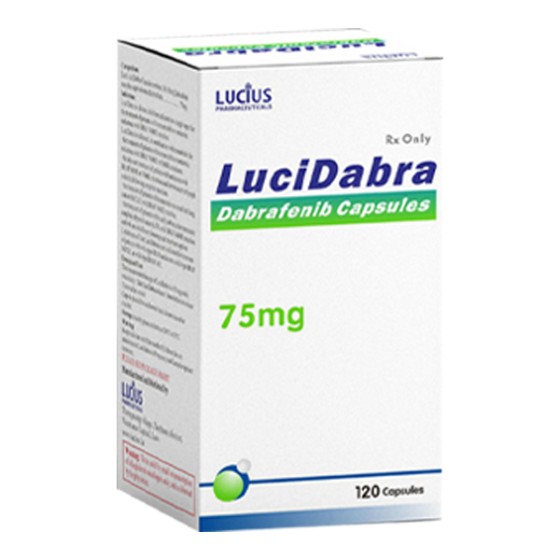
Lao-based compliant generics are a representative option.Relying on the country's WTO patent-waiver policy,several licensed manufacturers—Lucius Pharmaceuticals among them—produce dabrafenib generics with the same active ingredient as the originator,often priced at a small fraction of the brand.That said,bioequivalence data,long-term safety monitoring,and supply-chain traceability differ from the originator;batch-to-batch consistency,storage and shipping conditions(moisture-proof,heat-protected,away from direct sun),and source-channel compliance all deserve verification.Price alone is never a reliable proxy for quality.
Channel risks deserve a clear warning.Individual cross-border buyers and social-media resellers typically hold no medical or pharmaceutical import-export license,sources are untraceable,zero-active-ingredient counterfeits have been detected,and there is no customs clearance,quality testing,or after-sales support.Local small agencies may hold retail licenses but lack cross-border import-export and online-consultation qualifications,leaving the supply chain in a gray area with no standardized follow-up.Use a compliant platform and stay under the guidance of a prescribing physician and pharmacist.
5.Why It Is Combined with Trametinib
BRAF inhibition alone is typically followed by acquired resistance through MAPK pathway reactivation within 6–7 months.Adding trametinib—a MEK inhibitor—blocks the BRAF→MEK→ERK axis at two points:it extends progression-free survival and lowers the incidence of cutaneous squamous cell carcinoma and other secondary skin tumors associated with BRAF inhibition alone.
Key evidence.COMBI-AD established the adjuvant setting in stage III melanoma;the ROAR basket trial delivered standout results in ATC and remains the standard there;NCI-MATCH ECOG-ACRIN EAY131 subprotocol H enrolled 131 adults and reported response rates as high as 80%,supporting the tumor-agnostic indication.In a head-to-head pediatric LGG study,the combination achieved a 47%overall response rate versus 11%for the comparator,with median PFS of 20.1 versus 7.4 months(HR 0.31)—nearly a threefold extension.
An unresolved question.In first-line BRAF V600E-mutant NSCLC,no head-to-head prospective comparison exists between the targeted doublet and immune checkpoint inhibition.Both are reasonable;the choice hinges on PD-L1 expression,tumor burden,tolerability,and patient preference.
6.Managing Adverse Reactions
Serious febrile reactions.These are common in the combination setting,mostly grade 1–2 but capable of reaching 38°C or higher—occasionally 40°C—with hypotension and chills.Hold the dose at 38°C/100.4°F,rule out infection,assess renal function,and give antipyretics and fluids.Restart after fever resolves;recurrent fever calls for dose reduction.
Skin toxicity and new skin tumors.Full skin examinations are needed during treatment and for 6 months after stopping.New primary melanoma,papillomas,and seborrheic keratoses all warrant attention.CuSCC can usually be managed with surgical excision alone,without changing the dose.Grade 3–4 rash that does not improve within 3 weeks of holding the drug should prompt consideration of permanent discontinuation.
Bleeding and thrombosis.Serious hemorrhagic events including intracranial bleeding may occur.Watch for DVT and PE—lower-limb swelling,chest pain,or shortness of breath calls for urgent evaluation.
Other monitoring priorities.Cardiomyopathy(baseline LVEF,then at 1 month and every 2–3 months—mainly trametinib-related),ocular toxicity(any visual disturbance needs ophthalmologic assessment;uveitis persisting above grade 2 for more than 6 weeks may require permanent discontinuation),hyperglycemia(diabetic patients need glucose monitoring),G6PD-deficiency-associated hemolytic anemia,plus dehydration,hyponatremia,reduced appetite,neutropenia,and anemia.
Fertility and contraception.People of reproductive potential should use effective non-hormonal contraception during treatment and for at least 2 weeks after the last dose.Men should use condoms for the same period even after vasectomy.The drug carries an embryo-fetal risk;pregnancy must be excluded before starting.Breastfeeding is not recommended during therapy or for 2 weeks afterward.
7.Patient FAQs
Q:Does it have to be taken on an empty stomach?
A:Yes—at least 1 hour before or 2 hours after a meal,twice daily about 12 hours apart.Swallow capsules whole;do not open or chew.
Q:Is sun exposure safe during treatment?
A:Photosensitivity may increase.Avoid intense sunlight,use sunscreen and protective clothing,and perform monthly self-checks for new skin lesions.
Q:Do I have to stop the drug if I get a fever?
A:At 38°C/100.4°F or higher,hold the dose and contact your doctor to rule out infection and check renal function.Most patients restart once afebrile;recurrent high fever may require a dose reduction.
Q:Can a Lao generic replace the brand?
A:The active ingredient matches,and pricing is substantially lower,but bioequivalence and traceability differ.Discuss it with your oncologist in the context of your finances—do not source through unofficial channels.
Q:Does it work for BRAF fusions rather than V600E?
A:Dabrafenib targets V600E/K mutations.For BRAF fusion or rearrangement in pediatric LGG,the next-generation pan-RAF inhibitor tovorafenib(Ojemda)is FDA-approved for patients 6 months and older with relapsed or refractory disease;the neuro-oncology team should choose the regimen.
Q:What if I miss a dose?
A:If it is less than 6 hours until the next scheduled dose,skip it and resume the normal schedule.Never take a double dose.
[ 免责声明 ] 本页面内容来自公开渠道(如FDA官网、Drugs官网、原研药厂官网等),仅供持有医疗专业资质的人员用于医学药学研究参考,不构成任何治疗建议或药品推荐。所涉药品可能未在中国大陆获批上市,不适用于中国境内销售和使用。如需治疗,请咨询正规医疗机构。本站不提供药品销售或代购服务。