.jpeg)
Acoramidis (Attruby) for ATTR-CM: Stabilize TTR Tetramer, Reduce CV Death and Hospitalization
1.Disease and Role
Transthyretin amyloid cardiomyopathy(ATTR-CM)results from unstable TTR tetramers dissociating into monomers that misfold and deposit as amyloid in the myocardium,causing wall thickening,diastolic dysfunction,and progressive heart failure.Variant/hereditary forms carry TTR gene mutations;wild-type disease usually presents in older adults.
Acoramidis does not increase contractility or dilate vessels;it stabilizes the tetramer to reduce new amyloid formation.It is for confirmed adult ATTR-CM and aims to slow progression,lower cardiovascular death,and reduce CV-related hospitalization,not to dissolve existing deposits.
2.Pharmacology
Acoramidis binds TTR thyroxine-binding sites,mimics the stabilizing T119M variant through hydrogen-bond effects,and inhibits tetramer-to-monomer dissociation.Label pharmacology describes near-complete stabilization in relevant assays(≥90%stabilization occupancy).Less monomer availability reduces the substrate pool for fibril formation.
In ATTRibute-CM,serum TTR rose by about 28days on the recommended regimen,indicating tetramer retention;near-complete stabilization was sustained through 30months.Rising total TTR reflects stabilized tetramers,not regression of cardiac amyloid.
3.Indication and Dosing
Indication:adults with wild-type or variant transthyretin-mediated amyloid cardiomyopathy to reduce cardiovascular death and CV-related hospitalization.
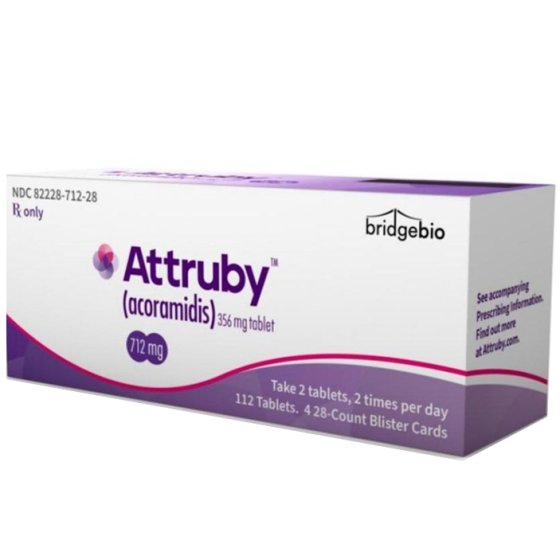
Dosing:Attruby 356mg tablets,2tablets(712mg)orally twice daily;with or without food;swallow whole without splitting,crushing,or chewing.Continue until progression,unacceptable toxicity,or shared re-assessment.Do not self-adjust.For missed doses follow prescriber instructions;never double.
Before start:amyloid probability score,bone scintigraphy(PYP/DPTA),serum free light chain and immunofixation to exclude AL;TTR gene testing when hereditary disease is possible.Both wild-type and variant patients may be considered,but genotyping guides family screening.
4.Key Trial Data
ATTRibute-CM(NCT03860935)was multicenter,randomized,double-blind,placebo-controlled in symptomatic adult ATTR-CM,wild-type or variant,2:1 allocation,up to30months.The four-part composite—all-cause death,CV hospitalization,NT-proBNP change,and 6-minute walk—showed win ratio about1.8(p<0.0001).
Biomarker and secondary outcomes:
NT-proBNP:30-month increase in the acoramidis arm was about half that with placebo,suggesting reduced myocardial stretch/progression;
troponin I:smaller rise versus placebo,consistent with less myocardial injury signal;
function/quality:Kansas City Cardiomyopathy Questionnaire and 6-minute walk improved versus placebo;
hard events:higher 30-month survival and lower CV hospitalization frequency in the active arm in published summaries(e.g.,~81%vs~74%survival;~50%relative reduction in CV hospitalization),but interpret by full paper and baseline severity.
Existing deposits do not rapidly disappear with stabilization;benefit is delayed progression,fewer hospitalizations,and lower death risk.
5.Safety and Monitoring
Common clinical events:diarrhea,upper abdominal pain,nausea,fatigue,headache;mostly grade1–2.Serious hypersensitivity is uncommon—stop and seek care for urticaria,dyspnea,or facial/lip/tongue swelling.
Laboratory and organ monitoring:
renal:serum creatinine may rise and eGFR fall,usually within4weeks and then stable;changes can partially reverse after stopping.Monitor closely with CKD,older age,or nephrotoxic combinations;
thyroid:TTR transports thyroxine,so free/total T4 and occasionally TSH may shift;check thyroid function periodically and avoid changing TTR therapy based on TSH alone;
liver:baseline and periodic ALT/AST despite low signal;
cardiovascular:track NYHA,weight,edema,hypotension,arrhythmias;use standard heart-failure therapy(ACEI/ARNI,beta-blocker,SGLT2 inhibitor,diuretics as appropriate)and do not stop TTR stabilizer automatically;
interactions:UGT/CYP considerations exist;review antiepileptics,rifampin-like inducers,warfarin/CYP2C9 substrates with a pharmacist.
Pregnancy,lactation,and pediatric data are limited;discuss reproductive planning before start.Older adults need no automatic dose cut for age but closer renal and tolerability follow-up.
6.Integrated Care
ATTR-CM requires more than one drug.Confirm with echocardiography,cardiac MRI T1mapping/ECV,nuclear bone imaging,AL exclusion by hematology,and TTR genetic counseling.Manage heart failure conservatively,avoid excessive digoxin and rapid volume shifts,and for variant disease discuss hepatic TTR silencing or gene-silencing strategy separately.Acoramidis is the myocardial-stabilization component aimed at lowering CV events.
[ 免责声明 ] 本页面内容来自公开渠道(如FDA官网、Drugs官网、原研药厂官网等),仅供持有医疗专业资质的人员用于医学药学研究参考,不构成任何治疗建议或药品推荐。所涉药品可能未在中国大陆获批上市,不适用于中国境内销售和使用。如需治疗,请咨询正规医疗机构。本站不提供药品销售或代购服务。