.jpeg)
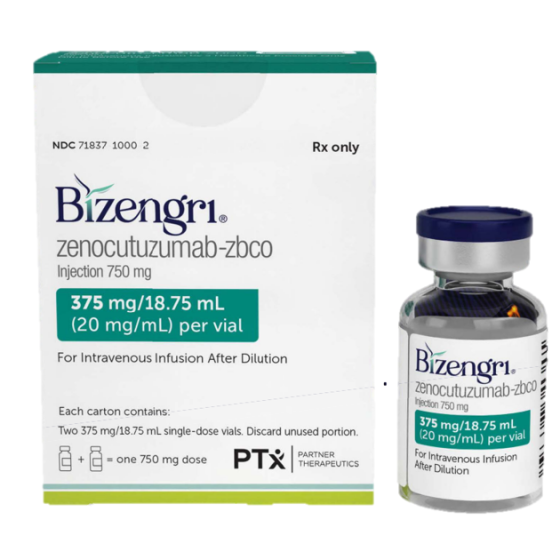
Zenocutuzumab (Bizengri) for NRG1 Fusion Solid Tumors: HER2×HER3 Bispecific, 750mg Q2W, NSCLC/Pancreas/Cholangiocarcinoma
1.Mechanism and Precision Scope
Zenocutuzumab-zbco(Bizengri)is a HER2/HER3 bispecific antibody that binds HER2 and HER3 extracellular domains,prevents NRG1 fusion protein from engaging HER3,blocks HER2-HER3 heterodimerization,and reduces PI3K-AKT-mTOR proliferative signaling;it can also mediate antibody-dependent cellular cytotoxicity.NRG1 fusions produce a constitutively active ligand context for HER3/ErbB pathways and occur in subsets of NSCLC,pancreatic adenocarcinoma,cholangiocarcinoma,and other tumors.Selection depends on confirmed NRG1 fusion rather than tumor site alone.
Testing should report NRG1,variant class fusion/rearrangement,partner gene,and method.DNA plus RNA NGS is preferred;if DNA NGS is negative but suspicion remains high,add RNA sequencing or use FISH/IHC per laboratory validation.Expression-only,point mutation,or amplification without fusion/rearrangement usually does not fit the approved population.
2.Indications and Boundaries
NSCLC:adults with unresectable or metastatic NRG1 fusion-positive disease and progression after prior systemic therapy.NRG1 fusion is about 0.3%of NSCLC,mostly adenocarcinoma backgrounds,but confirmation is mandatory.
Pancreatic adenocarcinoma:adults with unresectable or metastatic NRG1 fusion-positive disease and progression after prior systemic therapy.NRG1 fusion is about 0.5%of pancreatic cancer and defines an ultra-rare driver subset.
Cholangiocarcinoma:FDA expansion on May 8,2026 for adults with unresectable or metastatic NRG1 fusion-positive disease and progression after prior systemic therapy;the eNRGy biliary cohort was predominantly intrahepatic.
All three require validated NRG1 fusion,adult status,unresectable/metastatic stage,and prior systemic progression.Do not use without testing,with unclear NRG1 status,with non-fusion NRG1 alterations,or as default first line when standard regimens remain appropriate.
3.Dosing Administration
Standard IV regimen:750mg every 2 weeks until disease progression or unacceptable toxicity;the biliary program used 750mg Q2W with tumor assessment every 8 weeks.Administer the first infusion at controlled rate with allergy/infusion-reaction protocols;reschedule missed doses per institutional policy without doubling.Older adults,hepatic/renal impairment,and poorer performance status need more frequent monitoring per full prescribing information rather than empirical dose changes.
4.Key Efficacy(eNRGy,NCT02912949)
Multicenter,open-label,multi-cohort phase I/II in NRG1 fusion-positive advanced solid tumors,Response Evaluation Criteria in Solid Tumors version 1.1 by independent and/or investigator assessment.
NSCLC:about 64 evaluable patients,ORR 33%(95%CI 22%–46%),median DOR 7.4 months(95%CI 4.0–16.6).
Pancreatic adenocarcinoma:about 30 evaluable patients,ORR 40%(95%CI 23%–59%),DOR range 3.7–16.6 months.
Cholangiocarcinoma:22 enrolled,19 efficacy-evaluable,ORR 36.8%(95%CI 16.3–61.6),DOR 2.8–12.9 months;most had intrahepatic origin and metastatic,progressive disease after prior systemic therapy.
ORR indicates confirmed partial/complete response,not cure;DOR is median duration among responders.All datasets are single-arm/open,so conclusions apply to molecularly defined,previously progressed patients rather than to unselected tumors.
5.Safety and Monitoring
Common adverse events(≥10%pooled):diarrhea,musculoskeletal pain,fatigue,nausea,infusion-related reactions,dyspnea,rash,constipation,vomiting,abdominal pain,edema.Frequent laboratory abnormalities include elevated GGT,low hemoglobin,low sodium,thrombocytopenia,and AST/ALT,ALP,magnesium,phosphate,or bilirubin changes.
Key management:
Infusion/hypersensitivity:fever,chills,urticaria,bronchospasm,hypotension;slower first infusion and pause/treat per allergy protocol for moderate-severe reactions.
Diarrhea/GI:mild cases with fluids and diet;moderate-severe with antidiarrheal and workup for infection,obstruction,pancreatic/biliary causes.
Interstitial lung disease/pneumonitis:new cough,dyspnea,hypoxia,infiltrates—hold drug and involve pulmonology.
Left ventricular function:baseline and periodic echocardiographic EF when indicated;for heart-failure symptoms or significant EF drop,use cardio-oncology review for hold/reduction/discontinuation.
Embryo-fetal:pregnancy test in people with reproductive potential before start;contraception during therapy and for the post-treatment period stated in labeling;male contraceptive requirements per label.Avoid or interrupt breastfeeding per label.
Seek oncology review for severe dehydrating diarrhea,marked jaundice,acute dyspnea,chest pain/syncope,severe exfoliative rash,bleeding,or serious infection.
6.Precision Pathway
For rare-driver-suspected tumors—especially non-smoking lung adenocarcinoma,pancreatic ductal carcinoma,or intrahepatic cholangiocarcinoma with all standard drivers negative—send NGS early.NRG1-positive cases should be discussed in thoracic/gastrointestinal/biliary MDT to sequence zenocutuzumab against prior chemo/immunotherapy and local therapies.If another dominant driver exists(EGFR/ALK/ROS1/KRAS/IDH/FGFR2 etc.),use the corresponding pathway first;do not treat NRG1 empirically alongside unrelated targeted agents.
[ 免责声明 ] 本页面内容来自公开渠道(如FDA官网、Drugs官网、原研药厂官网等),仅供持有医疗专业资质的人员用于医学药学研究参考,不构成任何治疗建议或药品推荐。所涉药品可能未在中国大陆获批上市,不适用于中国境内销售和使用。如需治疗,请咨询正规医疗机构。本站不提供药品销售或代购服务。