.jpeg)
Pemigatinib for FGFR2 Cholangiocarcinoma and FGFR1 Hematologic Use: First-Line Data, 21-Day Dosing, Phosphate and Ocular Management
1.Mechanism and Molecular Selection
Pemigatinib selectively inhibits FGFR1,FGFR2,and FGFR3 and reduces downstream RAS-MAPK and PI3K-AKT signaling.In cholangiocarcinoma,approval-grade use focuses on FGFR2 fusion or rearrangement,with reports specifying partner gene,variant type,and assay.Isolated FGFR overexpression,variants of uncertain significance,or non-rearranged FGFR1/3 alterations do not reliably predict response.FGFR1-rearranged relapsed/refractory myeloid or lymphoid neoplasms represent a separate pathway with different scheduling and combination logic.
2.First-Line and Previously Treated Evidence
FIGHT-302 per supplied summary:in first-line advanced FGFR2-rearranged cholangiocarcinoma versus gemcitabine plus cisplatin,pemigatinib median PFS was 8.3 vs 6.8 months,HR about 0.58;ORR 47%vs 15%,median duration of response 14.2 vs 6.3 months;median OS 24.4 vs 25.0 months.Early closure and changing standards limit definitive“all FGFR2 first-line”conclusions.
FIGHT-202 per supplied summary:108 previously treated FGFR2 fusion/rearrangement cholangiocarcinoma patients had independent-review ORR about 37%,including 3 complete and 37 partial responses;median duration of response 9.1 months,median PFS 7.0 months,median OS 17.5 months;common events included hyperphosphatemia 58.5%,alopecia 49.7%,and diarrhea 47.6%.
Practical use:obtain FGFR2 testing in unresectable or recurrent disease;use posterior-line FGFR inhibition or trials if progression;discuss first-line targeted therapy by local approval,performance status,cholangitis risk,liver function,and shared decision-making.
3.Dosing Cycle and Missed Doses
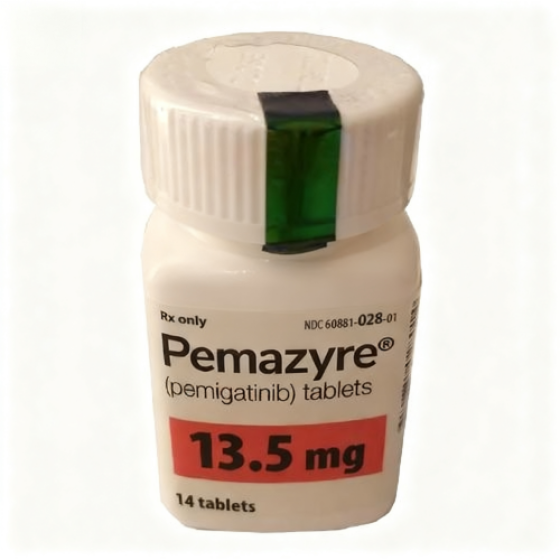
Cholangiocarcinoma:13.5mg orally once daily for 14 consecutive days,then 7 days off,repeating every 21 days;swallow whole,with or without food,do not crush,chew,or split.
FGFR1 hematologic indication:follow the specific prescription;do not apply the cholangiocarcinoma 14/7 pattern by analogy.Mark dosing calendars so the off week is not mistaken for missed therapy.
Missed or vomited dose:per supplied material,if a dose is missed by more than 4 hours or vomiting occurs after dosing,do not repeat;take the next scheduled dose.Never double to make up.Review strong/moderate CYP3A inhibitors or inducers,azole antifungals,certain antibiotics,antiepileptics,St John’s wort,and PPIs with a pharmacist before changes.
4.Hyperphosphatemia Management
FGFR inhibition often raises serum phosphate because FGFR helps regulate phosphate handling.Check phosphate,calcium,and renal function before therapy and at protocol-defined intervals.
Mild elevation:low-phosphate diet and trend monitoring;avoid indiscriminate calcium.
Moderate elevation:clinician-directed phosphate binders,hold,or dose reduction.
Severe/persistent elevation:hold pemigatinib,correct safely,restart per label;monitor for soft-tissue,skin,and vascular calcification with prolonged hyperphosphatemia,and for weakness or healing problems with hypophosphatemia.Patients should not self-start long-term calcium or phosphate supplements.
5.Ophthalmology and Visual Symptoms
Pemigatinib can cause retinal pigment epithelial detachment and other retinal issues,often asymptomatic early.
Baseline:visual acuity,fundus examination,and OCT before therapy;per supplied schedule,every 2 months for the first 6 months and every 3 months thereafter,more often with symptoms or risk factors.
Warning signs:blurred vision,photopsia,new floaters,visual field defects,or central scotoma—stop driving and high-risk tasks,arrange urgent OCT/fundus review.
Higher vigilance for diabetes,high myopia,macular disease,or prior retinopathy.If RPED affects vision,oncology and ophthalmology together decide hold,dose change,or switch.
6.Other Safety and Alarm Signs
Besides phosphate and ocular events,monitor alopecia,diarrhea,stomatitis,paronychia,skin/nail changes,fatigue,transaminase rises,hypocalcemia,creatinine,and electrolytes.Seek care for fever/infection,jaundice,persistent vomiting or dehydration,severe diarrhea,marked vision loss,or significant phosphate/calcium abnormalities;do not self-adjust.Pregnancy,lactation,severe hepatic impairment,or mandatory strong CYP3A combinations require individualized risk-benefit review.
[ 免责声明 ] 本页面内容来自公开渠道(如FDA官网、Drugs官网、原研药厂官网等),仅供持有医疗专业资质的人员用于医学药学研究参考,不构成任何治疗建议或药品推荐。所涉药品可能未在中国大陆获批上市,不适用于中国境内销售和使用。如需治疗,请咨询正规医疗机构。本站不提供药品销售或代购服务。