
.jpeg)
Detailed instructions for afatinib: mainly including indications, usage, dosage and precautions
Afatinib is a second-generation irreversible EGFR (epidermal growth factor receptor) tyrosine kinase inhibitor (TKI) developed by Boehringer Ingelheim under the trade name GIOTRIF. This drug effectively blocks the signaling of cancer cells by irreversibly inhibiting EGFR and its related family members (HER2, HER4), thereby inhibiting tumor growth. Compared with first-generation EGFR-TKIs (such as gefitinib and erlotinib), afatinib has stronger affinity and can inhibit EGFR signaling more persistently, and has been widely used to treat EGFR-mutated non-small cell lung cancer (NSCLC).
1. Indications
Afatinib has been approved by drug regulatory agencies in many countries and is mainly suitable for the following types of patientsNSCLC:
1. EGFR mutation-positive metastatic non-small cell lung cancer (NSCLC): Afatinib can be used as first-line treatment and is suitable for patients carrying EGFR activating mutations (such as exon 19 deletion Del19 or L858R mutation). Clinical studies have shown that afatinib's progression-free survival (PFS) and objective response rate (ORR) are significantly better than traditional chemotherapy in such patients.
2. Local advanced or metastatic squamous NSCLC after failure of platinum-based chemotherapyNSCLC: Afatinib is approved for patients with squamous NSCLC who have failed platinum-based chemotherapy. Compared with erlotinib, afatinib can significantly improve patients' overall survival (OS), reduce the risk of disease progression, and improve quality of life.
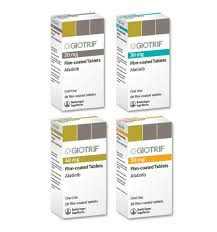
2. Usage and dosage
The standard dose of afatinib is 40 mg once daily, administered orally until disease progression or intolerance. Patients should take it on an empty stomach, i.e. at least 1 hour before or 2 hours after meals, to ensure optimal absorption. If the patient experiences serious side effects, the dose can be adjusted under the guidance of a doctor.
For patients with impaired renal function, the dose of afatinib needs to be adjusted based on renal function:
(1)Patients with mild to moderate renal impairment (eGFR 30-89 ml/min): No dose adjustment is required, but drug tolerance needs to be closely monitored.
(2)Patients with severe renal impairment (eGFR <30 ml/min): The recommended dose is reduced to 30 mg once daily, and adverse reactions should be closely monitored.
(3) Patients with end-stage renal disease: Due to the low renal clearance of afatinib, there is currently insufficient data to support its use in dialysis patients, and it needs to be carefully considered after weighing the risks.
If the patient misses a dose of afatinib, if it is more than 8 hours before the next dose, the patient can take it as soon as possible; if it is less than 8 hours, the current dose should be skipped and the dose cannot be doubled.
3. Precautions
The safety and efficacy of afatinib have been verified in multiple clinical studies, but the following matters still need to be noted to reduce adverse reactions and improve treatment effects:
1. Adverse reaction management
Common adverse reactions of afatinib mainly include diarrhea, rash, stomatitis, decreased appetite and onychomycosis. Among them, diarrhea is the most common adverse reaction, and some patients may experience grade 3 or above diarrhea, which may even lead to dehydration or electrolyte imbalance. Therefore, it is recommended that patients maintain adequate fluid intake while taking the medication and use antidiarrheal drugs (such as loperamide) under the guidance of a doctor. If diarrhea is severe (≥Grade 3), a brief discontinuation or dose reduction may be required.
Skin toxicity (such as rash, stomatitis) is related tothe mechanism of action of EGFR-TKI drugs. Patients should avoid sun exposure and use moisturizers and sunscreen to reduce skin irritation. Severe cutaneous adverse reactions may require topical or systemic anti-inflammatory treatment or even dose adjustment.
2. Drug interactions
Afatinib is transported and metabolized by P-gp (P-glycoprotein), so co-use with P-gp inhibitors or inducers may affect its plasma concentration. For example:
P-gp inhibitors (such as ritonavir, itraconazole) may increase the plasma concentration of afatinib, and the dose needs to be adjusted carefully.
P-gp inducers (such as rifampicin, carbamazepine) may reduce the efficacy of afatinib and should be avoided or the dose of afatinib should be increased.
In addition, afatinib may affect the pharmacokinetics of certain drugs metabolized by CYP3A4 (such as warfarin, oral contraceptives). Therefore, careful evaluation is required when coadministering drugs.
3. Medication for special groups of people
Elderly patients (≥65 years old): No dose adjustment is required, but tolerance needs to be closely monitored.
Patients with hepatic impairment: Patients with mild to moderate hepatic impairment do not need to adjust the dose, but patients with severe hepatic impairment should use it with caution as it may affect drug metabolism and clearance.
Pregnancy and lactation: Afatinib may cause fetal toxicity and is contraindicated in pregnant women. Women of childbearing age should take effective contraceptive measures. Breastfeeding patients should stop breastfeeding to avoid affecting the baby.
4. Drug resistance issues
As with allEGFR-TKIs, the efficacy of afatinib may be affected by resistance mutations. The most common resistance mechanism is the T790M mutation. At this time, the effect of afatinib will be greatly reduced, and it needs to be replaced with a third-generation EGFR-TKI (such as osimertinib). For patients with non-T790M mutation resistance, combined chemotherapy or other targeted drugs may be needed for treatment.
Reference materials:https://www.giotrif.com/
[ 免责声明 ] 本页面内容来自公开渠道(如FDA官网、Drugs官网、原研药厂官网等),仅供持有医疗专业资质的人员用于医学药学研究参考,不构成任何治疗建议或药品推荐。所涉药品可能未在中国大陆获批上市,不适用于中国境内销售和使用。如需治疗,请咨询正规医疗机构。本站不提供药品销售或代购服务。


