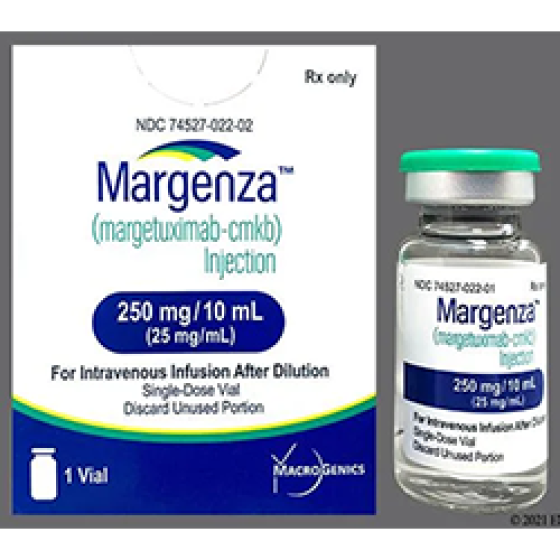
.jpeg)
Onset Timeline and Efficacy Assessment of Margetuximab plus Chemotherapy in HER2-Positive Metastatic Breast Cancer
1. Onset of Clinical Response
In patients with HER2-positive metastatic breast cancer treated with margetuximab plus chemotherapy, the median time to first objective response is approximately 1.8 months (7–8 weeks), according to the SOPHIA study. Tumor shrinkage may be observed as early as the first radiographic assessment (week 6–8). Complete responses typically require 3–4 months of continuous therapy.
2. Standardized Efficacy Monitoring
- •
Initial Evaluation: Conduct CT or MRI at 8–12 weeks (after 2–3 cycles) using RECIST 1.1 criteria.
- •
Follow-up: If stable or responding, repeat imaging every 8–12 weeks.
- •
Biomarkers: Serum markers (e.g., CA15-3, CEA) may support monitoring but cannot replace imaging.
3. Key Efficacy Data
The SOPHIA trial demonstrated an objective response rate (ORR) of 22% for margetuximab plus chemotherapy versus 16% for trastuzumab plus chemotherapy (p=0.06). Median progression-free survival (PFS) was 5.8 vs 4.9 months (HR=0.76). In the CD16A 158F/F genotype subgroup, ORR increased to 24% (vs 14%) and PFS to 6.9 months (vs 5.1 months).
4. Factors Influencing Response Time
- •
Genotype: Faster onset and greater PFS benefit in CD16A 158F/F carriers.
- •
Prior Lines of Therapy: Later-line treatment (≥3 lines) correlates with slower response and lower ORR.
- •
Brain Metastases: Intracranial responses may take up to 3 months.
- •
Performance Status: Patients with ECOG 0–1 respond faster than those with ECOG 2.
5. Defining Treatment Failure
Primary resistance should be considered if imaging at week 12 (after 3 cycles) shows progressive disease (≥20% target lesion growth or new lesions). Discontinue margetuximab and consider alternative therapies (e.g., trastuzumab deruxtecan).
[ 免责声明 ] 本页面内容来自公开渠道(如FDA官网、Drugs官网、原研药厂官网等),仅供持有医疗专业资质的人员用于医学药学研究参考,不构成任何治疗建议或药品推荐。所涉药品可能未在中国大陆获批上市,不适用于中国境内销售和使用。如需治疗,请咨询正规医疗机构。本站不提供药品销售或代购服务。