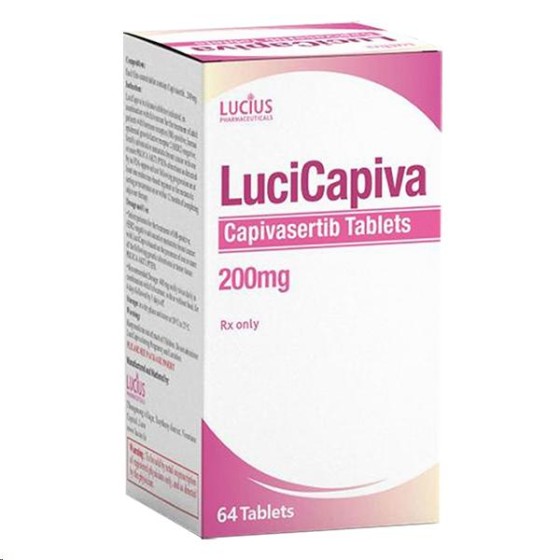
.jpeg)
Capivasertib (Truqap) Complete Medication Guide: Indications, Dosing, Safety, and Precautions
1.Drug Overview and Indications
Capivasertib(brand name Truqap)is an oral,highly selective ATP-competitive AKT(protein kinase B)inhibitor developed by AstraZeneca.Approved by the U.S.FDA in November 2023 as a first-in-class agent,it works by inhibiting aberrant activation of the PI3K/AKT/mTOR signaling pathway,thereby blocking tumor cell proliferation and survival signals.
Capivasertib in combination with fulvestrant is indicated for adult patients with estrogen receptor(ER)-positive,HER2-negative locally advanced or metastatic breast cancer who harbor one or more PIK3CA,AKT1,or PTEN alterations and have experienced recurrence or disease progression following endocrine therapy.
For premenopausal or perimenopausal women,a luteinizing hormone-releasing hormone(LHRH)agonist should be administered concurrently with the capivasertib-fulvestrant combination.Male patients should also consider LHRH agonist use per current clinical practice standards.
2.Dosage and Administration
Treatment with capivasertib should be initiated and supervised by a physician experienced in the use of antineoplastic agents.Prior to treatment,patients must have confirmed PIK3CA/AKT1/PTEN alterations in tumor tissue via a validated assay.
The recommended dose is 400 mg(two 200 mg tablets)taken orally twice daily,approximately 12 hours apart,for 4 consecutive days followed by 3 days off,constituting one weekly cycle.Capivasertib may be taken with or without food.Tablets must be swallowed whole with water and must not be chewed,crushed,dissolved,or split.Do not take tablets that are broken,cracked,or otherwise incomplete.
Fulvestrant is administered at 500 mg intramuscularly on Days 1,15,and 29,then once every 28 days thereafter.
If a dose is missed,it may be taken within 4 hours of the usual dosing time.If more than 4 hours have passed,skip the missed dose and take the next dose at the regularly scheduled time.At least 8 hours should separate consecutive doses.If vomiting occurs after taking a dose,do not take an additional dose;take the next dose at the regularly scheduled time.Treatment should continue until disease progression or unacceptable toxicity.
3.Special Populations
No dose adjustment is required for elderly patients,although data in patients aged 75 and above are limited.No dose adjustment is needed for mild or moderate renal impairment;however,use is not recommended in severe renal impairment due to lack of safety and pharmacokinetic data.No dose adjustment is required for mild hepatic impairment;caution is advised in moderate hepatic impairment,with use only when benefit outweighs risk and close toxicity monitoring is in place.Use is not recommended in severe hepatic impairment.
Safety and efficacy have not been established in pediatric patients aged 0 to 18 years.Women of childbearing potential must confirm they are not pregnant before initiating therapy and use effective contraception during treatment and for 4 weeks after the last dose.Males should use effective contraception during treatment and for 16 weeks after the last dose.The drug is contraindicated during pregnancy,and breastfeeding should be discontinued during treatment.Capivasertib may cause testicular toxicity and potentially affect male fertility.
4.Warnings and Precautions
Hyperglycemia is a critical adverse effect requiring close attention,with severe cases potentially leading to diabetic ketoacidosis(DKA).Fasting blood glucose and HbA1c should be assessed before treatment initiation.Blood glucose should be monitored regularly during therapy,particularly during the first 8 weeks.Diabetic patients require daily monitoring.Symptoms such as polydipsia,polyuria,nausea,vomiting,abdominal pain,dyspnea,or fruity breath odor warrant immediate medical attention.If DKA is suspected,capivasertib should be withheld immediately;if confirmed,the drug must be permanently discontinued.Metformin is the preferred hypoglycemic agent,but attention must be paid to its interaction with capivasertib—it should only be taken on days when capivasertib is administered,with creatinine monitoring.
Diarrhea is a very common adverse reaction that may lead to dehydration,hypokalemia,and acute kidney injury.Antidiarrheal treatment and fluid replacement should begin immediately at the first sign of diarrhea.Maintaining intravascular volume and electrolyte balance is critical.
Skin reactions including erythema multiforme and exfoliative dermatitis may occur.Early dermatology consultation is recommended.Secondary prophylaxis should be considered for patients with persistent rash or a history of Grade 3 rash.
Data are limited in patients with symptomatic visceral disease,significant cardiac history(including QTcF greater than 470 msec),insulin-requiring diabetes,or HbA1c greater than 8.0%.Caution is warranted when prescribing in these populations.Given the potential for fatigue,dizziness,and syncope,the drug may slightly impair the ability to drive or operate machinery.
5.Drug Interactions
Strong or moderate CYP3A4 inhibitors(e.g.,itraconazole,clarithromycin,grapefruit juice)increase capivasertib exposure and toxicity risk;co-administration should be avoided or the capivasertib dose reduced.Strong or moderate CYP3A4 inducers(e.g.,rifampin,St.John's wort,carbamazepine)decrease capivasertib concentrations and may reduce efficacy;co-administration should be avoided.
Capivasertib itself is a weak inhibitor of CYP3A4,CYP2D6,and UGT1A1,an inducer of CYP2B6,and an inhibitor of multiple transporters(including OCT2 and BCRP).Co-administration with drugs metabolized or transported by these pathways(e.g.,midazolam,simvastatin,metformin,irinotecan)may alter their plasma concentrations,particularly for narrow therapeutic index drugs requiring careful evaluation and potential dose adjustment.
6.Adverse Reactions
Very common adverse reactions(incidence≥10%)include:diarrhea(72.4%),rash(40.6%),nausea(34.6%),fatigue(32.1%),vomiting(21.4%),hyperglycemia(19.2%),stomatitis(18.6%),headache(17.2%),decreased appetite(16.9%),urinary tract infection(16.6%),as well as anemia,pruritus,alopecia,and weight loss.
Common adverse reactions include hypokalemia,dizziness,syncope,dyspepsia,dry mouth,abdominal pain,dry skin,erythema multiforme,hypersensitivity reactions,acute kidney injury,elevated blood creatinine,pyrexia,mucosal inflammation,and elevated HbA1c.Uncommon adverse reactions include drug rash,dermatitis,exfoliative dermatitis,toxic rash,and ketoacidosis.
The most common serious adverse reactions are rash(2.3%)and diarrhea(2.5%).Dose reductions and treatment discontinuations due to adverse events occurred in 18.9%and 10.4%of patients,respectively,with diarrhea and rash being the primary causes.
7.Contraindications and Storage
Capivasertib is contraindicated in patients with known hypersensitivity to capivasertib or any excipient of the product.No special storage conditions are required.Keep out of reach of children.
[ 免责声明 ] 本页面内容来自公开渠道(如FDA官网、Drugs官网、原研药厂官网等),仅供持有医疗专业资质的人员用于医学药学研究参考,不构成任何治疗建议或药品推荐。所涉药品可能未在中国大陆获批上市,不适用于中国境内销售和使用。如需治疗,请咨询正规医疗机构。本站不提供药品销售或代购服务。