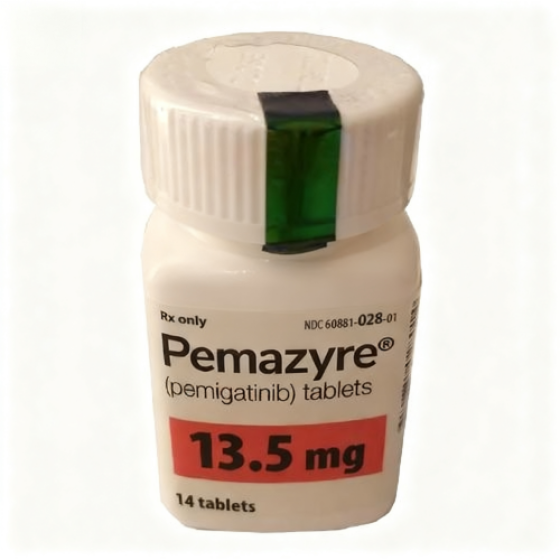
.jpeg)
Pemigatinib vs. Anlotinib: Key Differences Between FGFR-Targeted Therapy and Multi-Target Anti-Angiogenic Treatment
Defining the Distinction Between Two Targeted Therapies
Although both pemigatinib and anlotinib belong to the category of anti-tumor targeted agents,they differ fundamentally in mechanism of action,target selection,applicable cancer types,and intended patient populations.It is therefore inappropriate to simply determine which drug is"more effective."The most critical distinction lies in their targeting strategy:pemigatinib is a highly selective inhibitor directed at FGFR gene abnormalities,representing precision gene-driven therapy,while anlotinib is a multi-target anti-angiogenic agent with a relatively broader scope of application.The two drugs are not interchangeable but rather serve distinct clinical scenarios.
Pemigatinib:Precision Blockade of the FGFR Pathway
Pemigatinib is a selective FGFR1-3 inhibitor whose primary mechanism involves blocking aberrant activation of the fibroblast growth factor receptor(FGFR)pathway.FGFR signaling plays a significant role in tumor cell proliferation,survival,and angiogenesis.When tumors such as cholangiocarcinoma harbor FGFR2 fusions or rearrangements,cancer cells often become heavily dependent on this pathway for sustained growth.By precisely inhibiting aberrant FGFR signaling,pemigatinib disrupts the driving pathway upon which tumors rely,thereby exerting its anti-tumor effect.Currently,the most important clinical application of pemigatinib is in advanced cholangiocarcinoma(CCA)harboring FGFR2 fusions or rearrangements,with additional exploration in certain FGFR-associated hematologic malignancies.In genetically selected patient populations,pemigatinib has demonstrated clear therapeutic value.
Anlotinib:Multi-Target Anti-Angiogenic Strategy
Anlotinib is a multi-target tyrosine kinase inhibitor that simultaneously acts on VEGFR,PDGFR,FGFR,and other targets.It primarily exerts anti-tumor effects by inhibiting tumor neoangiogenesis and partially blocking tumor growth signaling.Anlotinib has found application across multiple tumor treatment areas including lung cancer and soft tissue sarcoma.Due to its multi-target profile,anlotinib does not require patients to carry a specific gene mutation,making its clinical scope broader than that of pemigatinib.
Precision and Patient Selection
From the perspective of treatment precision,pemigatinib represents a quintessential"gene-driven targeted therapy."It can only exert its highly targeted therapeutic effect when patients are confirmed through genetic testing to harbor FGFR2 fusions or other qualifying FGFR abnormalities.Anlotinib,as a broad-spectrum anti-angiogenic targeted agent,may be selected based on disease stage and overall treatment strategy even in the absence of a defined FGFR gene abnormality.Therefore,the two drugs play different roles in clinical decision-making and are not substitutes for one another.
Adverse Effect Profiles
Due to differing mechanisms of action,the adverse effect spectra of the two drugs are notably distinct.Pemigatinib's common adverse reactions are closely related to FGFR pathway inhibition and include hyperphosphatemia,stomatitis,alopecia,ocular-related issues,and skin and nail changes.Anlotinib's common adverse reactions primarily stem from its anti-angiogenic activity and include hypertension,fatigue,hand-foot syndrome,and proteinuria.Clinical monitoring and management strategies should be tailored to the specific adverse effect profiles of each agent.
Cost and Accessibility Considerations
From an economic burden perspective,pemigatinib,as a highly selective targeted agent,carries a relatively high overall treatment cost,and long-term use places certain demands on patients'financial capacity.Some patients may explore overseas generic versions as alternatives to reduce the economic pressure of sustained therapy.Anlotinib benefits from relatively mature supply channels,making patient access more convenient,and the overall financial burden may be comparatively lower.Specific costs vary by region,specification,and supply channel,and patients are advised to discuss financial planning thoroughly with their medical team before initiating treatment.
Summary and Treatment Selection Guidance
There is no absolute superiority in efficacy between pemigatinib and anlotinib;the key determinant lies in the patient's specific disease type and molecular characteristics.For patients with cholangiocarcinoma harboring FGFR2 fusions or rearrangements who meet the indication criteria,pemigatinib represents a more precise targeted therapy option.For patients requiring a broader anti-angiogenic treatment strategy,anlotinib offers distinct clinical application value.The ultimate drug selection should comprehensively consider tumor type,genetic testing results,prior treatment history,patient physical condition,and financial capacity,with an individualized treatment plan developed by a specialized medical team.
[ 免责声明 ] 本页面内容来自公开渠道(如FDA官网、Drugs官网、原研药厂官网等),仅供持有医疗专业资质的人员用于医学药学研究参考,不构成任何治疗建议或药品推荐。所涉药品可能未在中国大陆获批上市,不适用于中国境内销售和使用。如需治疗,请咨询正规医疗机构。本站不提供药品销售或代购服务。